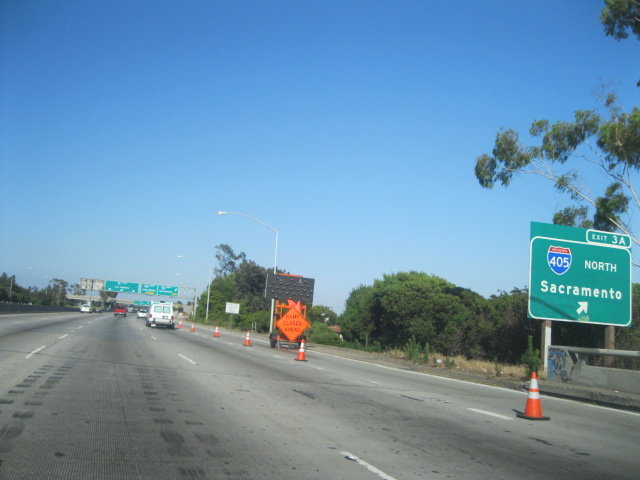
Smooth sailing on the 10 approaching the closed 405 interchange, during rush hour on Saturday
When you think of the last big, over-hyped anything in LA, there’s lots of competition. But when it came to the dreaded Carmageddon, a term coined by Los Angeles County Supervisor Zev Yaroslavsky and usurped from a violent videogame of a few years back, the message got through.
There were huge freeway signs. There were social media campaigns. There was endless news coverage on radio and television. You had to be living under a rock– and true to the LA lifestyle, some people were up to a few days beforehand– not to know that the 405 freeway was going to be closed for 10 miles between the Valley and the city, between the 101 and the 10.
The specter of that lifeline being cut , and the fear of being caught in massive hours-long traffic jams led the obedient citizens of Los Angeles to take direction from government officials and stay home or close to home– and definitely off the roads.
The threat was very real, because everyone has their own repertoire of traffic nightmare stories. Can I tell you about the time I was stuck on the angled, connector bridge between the 10 E. and the 405 N. for 45 minutes, and how I’ve barely been to the Valley since? Or how it took an hour and fifteen minutes to get from Santa Monica to West Hollywood the night before the big C?
On a larger scale, the last big citywide jam had huge repercussions. When Pres. Obama came to town last summer, there was apparently little planning on how his motorcade and the road closures it forced would affect normal people, who were not really warned that they might be stuck for hours– which is exactly what happened. Talk about road rage.
On his next visit, there was serious traffic management in place because locals would not stand for that sort of unnecessary trauma again.
Back to this weekend, the lack of traffic created idyllic situations all overLos Angeles. Fears that surface streets, particularly the canyons like Coldwater, Beverly Glen and Laurel would become gridlocked did not materialize. Westward, there was no one onPCH and the beaches were wide open. People going to a soccer match at the Coliseum in ExpositionPark, who had left hours early, instead got there in record time.
Things went so well on Saturday that there were fears that everyone would hit the road on Sunday. Saturday night, there was the only-in-LA drama, that ex-con and his girlfriend, who led police and CHP officers on a three-hour long, 120-mile chase across Southern California freeways before being captured.
Instead, what happened, to most people’s shock, is that the 405– known to locals as the San Diego Freeway– re-opened a tnoon, rather than staying shut until 6 a.m.Monday morning. The contractor got a bonus and the city saved money– about $300,000. And all of the politicians were out on the roadway to take credit, like LA mayor Antonio Villaraigosa and Yaroslavsky.
Mayor V. noted that people had loved the weekend so much that it was definitely worth considering some sort of future “traffic-free” situations in the city. (And of course, there’s the scheduled son of Carmageddon next June, when the other half of the Mulholland Bridge is demolished to make way for a new carpool lane.)
We would be willing to donate the cost of a tank of gas to support that concept. The thrill of seeing big flashing signs that said “405 Fwy Now Open. Thank You Los Angeles” was worth all the anxiety and dread the closure caused—and gave us a big dose of civic pride, an all too infrequent emotion.