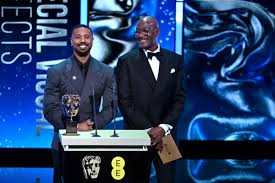
The British Academy of Film and Television Arts is facing mounting backlash after a racial slur was audibly broadcast during the BAFTA Film Awards telecast, in a moment involving “Sinners” stars Michael B. Jordan and Delroy Lindo that has since ignited debate over live-event safeguards, editorial judgment and institutional accountability.
The incident occurred as Jordan and Lindo were onstage presenting an award Sunday night during the London ceremony. A racial slur — the N-word — was shouted from the audience by John Davidson, a Tourette syndrome campaigner whose life inspired the nominated film “I Swear”. The outburst, stemming from involuntary vocal tics associated with Tourette syndrome, was heard clearly in the BBC’s edited broadcast on BBC One and remained available on BBC iPlayer overnight before being removed.
BBC producers overseeing the ceremony from an outside broadcast truck have said they did not hear the slur during post-production, despite the telecast airing two hours after the live event — a delay that typically allows time for editorial adjustments. Other instances of strong language were removed from the broadcast, including a “Free Palestine” remark by outstanding British debut winner Akinola Davies Jr., a joke by host Alan Cumming that appeared to reference Donald Trump, and the word “piss” uttered by best film and director winner Paul Thomas Anderson.
The BBC initially issued a brief apology noting that “some viewers may have heard strong and offensive language” and explaining that the outburst arose from involuntary tics. As criticism mounted, the corporation followed with a more direct apology, confirming the moment would be edited out of the iPlayer version.
BAFTA released its own statement the following day, acknowledging “very offensive language that carries incomparable trauma and pain for so many” and accepting responsibility for placing guests “in a very difficult situation.” The organization said it had made efforts to inform attendees about potential tics during the ceremony and pledged to “keep inclusion at the core of all we do.”
The political fallout was swift. U.K. Conservative Party leader Kemi Badenoch criticized the broadcaster for failing to bleep the slur while editing out other remarks. “It should have been bleeped,” she said on ITV’s “Good Morning Britain”, calling the lapse a “horrible mistake” and suggesting that Jordan and Lindo were likely left blindsided onstage.
According to reports from Vanity Fair, Lindo later told a reporter at an afterparty that he and Jordan “did what we had to do” by maintaining composure at the podium, but added that he wished “someone from Bafta spoke to us afterwards.” Representatives for both actors have not issued formal statements.
Industry reaction has underscored the tension between understanding the neurological basis of Tourette-related tics and centering the harm caused by the slur’s broadcast. Jamie Foxx called the moment “unacceptable,” while Wendell Pierce wrote that the “insult” to Lindo and Jordan “takes priority. It doesn’t matter the reasoning for the racist slur.”
“Sinners” production designer Hannah Beachler said on social media that she, too, had experienced a racial slur during the evening and criticized BAFTA’s apology as insufficient.
Davidson, who was born in Galashiels, Scotland, and first came to public attention in the 1989 documentary “John’s Not Mad”, later said he was “deeply mortified if anyone considers my involuntary tics to be intentional or to carry any meaning.” Appointed an MBE in 2019 for services to people with Tourette syndrome, Davidson added that he left the auditorium early after realizing the distress his tics were causing.
Advocacy group Tourettes Action released a statement emphasizing that vocal tics are neurological and involuntary. “They are not a reflection of a person’s beliefs, intentions, or character,” the group said, while acknowledging the pain such language can cause.
For the BBC, the controversy revives scrutiny over editorial standards following criticism last year for streaming a contentious performance by punk-rap duo Bob Vylan from Glastonbury with only a content warning attached. This time, the questions center on how a delayed awards broadcast — with multiple edits already made — allowed one of the most inflammatory words in the English language to pass through uncut.
Within industry circles, the episode has prompted broader conversations about live-event protocols when accommodating neurodivergent guests, crisis response communication and the optics of selective censorship. For BAFTA and its broadcast partner, the path forward may hinge not only on technical safeguards but also on rebuilding trust with talent who found themselves at the center of an incident not of their making.