To bring HoD’s third season to a conclusion, “The Treasons of Tumbleton” finally delivers the kind of bloody, operatic spectacle that HBO’s Game of Thrones prequel has been promising since its premiere. The episode turns the Targaryen civil war into something considerably more horrifying than a family squabble over a crown. By the time the smoke clears, alliances have collapsed and virtually every major player has taken another step toward the abyss. The episode makes clear that there are no real winners in the Dance of the Dragons—only survivors waiting for their turn to lose everything.
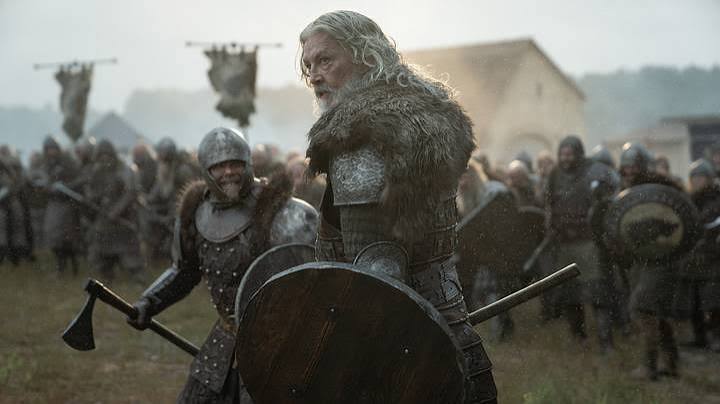
The centerpiece is the Battle of Tumbleton, where the Greens and Blacks collide in spectacularly brutal fashion. The battle is everything viewers have come to expect from House of the Dragon: enormous armies, shifting loyalties, dragons raining fire from the sky and characters discovering that war has a nasty habit of refusing to follow anyone’s plan.
The biggest wild card is Ulf the White, played by Tom Bennett, whose allegiance proves about as dependable as a Westerosi peace treaty. His betrayal sends the battle spiraling into chaos as dragonfire consumes soldiers and civilians alike. Tumbleton becomes less a military victory than a demonstration of what happens when dragons are unleashed without anyone capable of controlling them.
The sequence also provides one of the finale’s strangest—and most memorable—deaths. Lord Ormund Hightower, played by James Norton, meets an ignominious end when Roddy the Ruin, played by Tommy Flanagan, stabs him from behind before the two are ultimately consumed by dragonfire. Norton has described the deliberately grotesque sequence, including the indignity of the fatal wound, as a mixture of brutality and dark comedy. It is quintessential House of the Dragon: gruesome, absurd and tragic almost simultaneously.
But the real horror of the finale takes place away from the battlefield.
Emma D’Arcy’s Rhaenyra has spent much of the series trying to convince herself—and everyone around her—that she is fighting for justice and legitimacy. In the finale, that increasingly becomes difficult to believe. Her decision to execute the High Septon after he refuses to recognize her authority is a particularly ominous turning point. She is no longer merely claiming the throne; she is demanding obedience.
It is impossible not to think of another Targaryen queen.
The series has been carefully constructing parallels between Rhaenyra and Daenerys for years, and the finale pushes that comparison into uncomfortable territory. The woman who once seemed destined to restore order increasingly resembles the kind of ruler who believes that her claim to power gives her permission to do whatever is necessary to obtain it.
That makes D’Arcy’s performance especially effective. Rhaenyra doesn’t suddenly become a monster. Instead, we watch the exhaustion, grief and frustration gradually strip away whatever restraint she had left.
And then there is Helaena.
Phia Saban’s Queen Helaena has always occupied an unusual place in the series, possessing prophetic abilities while remaining emotionally removed from the political games surrounding her. Her suicide becomes one of the finale’s most haunting moments, while the imagery of her prophetic tapestry suggests that Rhaenyra’s reign is heading toward catastrophe.
Olivia Cooke’s Alicent is left in an equally bleak position. Having spent years attempting to preserve her family and influence, she is increasingly powerless as the men around her turn the kingdom into a slaughterhouse. Her decision to poison Aemond and then flee into the woods is less a triumph than an admission that she has lost control of the world she helped create.
Meanwhile, Tom Glynn-Carney continues to make Aegon one of the show’s most fascinating characters.
The once-dismissed king returns to the story with renewed purpose, confronting Aemond and making it clear that he intends to reclaim the Iron Throne. Glynn-Carney has transformed Aegon from a deeply unpleasant, seemingly doomed monarch into something far more complicated: pathetic, damaged, sometimes monstrous and yet increasingly sympathetic. Showrunner Ryan Condal has singled out Glynn-Carney’s work as one of the season’s highlights.
His confrontation with Ewan Mitchell’s Aemond is one of the finale’s essential pieces of unfinished business. Aemond has spent the season becoming increasingly unstable, and his obsession with power and Vhagar has pushed him toward a confrontation with virtually everyone around him.
Now Aegon wants him back in the fight. That is very bad news for everybody.
Season 3 began with the Battle of the Gullet and immediately established that this would be a bloodier chapter of the Targaryen story. Jacaerys died, Criston Cole fell, the war expanded and the competing factions became increasingly unrecognizable
Now Tumbleton has taken the conflict to another level.
The irony is that after three seasons of characters obsessing over who deserves the Iron Throne, the finale increasingly makes the throne itself seem almost irrelevant. What matters now is survival.
And there is one more battle still to come.
Condal has confirmed that Season 4 will be the show’s final season and will consist of eight episodes, bringing the Dance of the Dragons to its conclusion. That leaves House of the Dragon with a formidable challenge: turning all this devastation into a satisfying ending.
For now, however, the S3 finale accomplishes something the series has occasionally struggled to do. It makes the war feel consequential. It makes the dragons terrifying again. And it leaves virtually every major character in a worse position than where they started.
Which, in Westeros, is probably the closest thing to a happy ending anyone should expect.