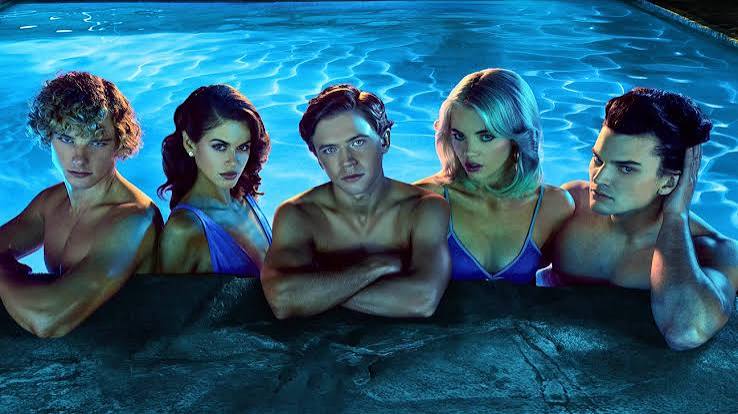
There may be no better television playground for Ryan Murphy than the Los Angeles of Bret Easton Ellis’ imagination: beautiful people, beautiful houses, beautiful clothes — and something deeply rotten lurking just beneath the surface.
The Shards, FX’s lavish adaptation of Ellis’ semi-autobiographical 2023 novel, is a deliciously dark marriage of coming-of-age drama, erotic thriller, murder mystery and L.A. time capsule. Set in 1981, the nine-episode series follows a fictionalized 17-year-old Bret Ellis (Igby Rigney), a privileged Buckley School student who is simultaneously discovering his sexuality, nurturing ambitions as a writer and becoming increasingly obsessed with a terrifying serial killer known as the Trawler.
The series premiered August 5 on FX and Hulu, and it quickly becomes clear that The Shards is less interested in delivering a conventional whodunit than in immersing viewers in a particular state of mind: the paranoid, narcissistic, horny, intoxicatingly privileged consciousness of an adolescent who believes he may be the smartest person in the room — and may also be the person most capable of imagining monsters where none exist.
That ambiguity is the show’s secret weapon.
Rigney is terrific as Bret, playing him not as a sympathetic innocent but as a fascinatingly unreliable observer. He is vain, observant, sexually confused, ambitious and often insufferable — precisely the combination that makes him such an entertaining guide through this sinister world. Bret is simultaneously participating in the superficiality around him and documenting it in his head, already becoming the writer he will eventually be.
And what a world it is.
Murphy and his creative team have recreated 1981 Los Angeles with astonishing specificity. This isn’t the neon-and-legwarmers version of the ’80s that has become standard television shorthand. The production design digs into the transitional moment between the late ’70s and early ’80s, filling the series with expensive homes, period furniture, carefully selected artwork, era-specific phones, cars and clothes.
The result feels less like nostalgia than an actual memory — which is particularly appropriate for a story in which memory itself cannot always be trusted. The houses may be the show’s most spectacular supporting characters. Wealth is everywhere, but it doesn’t feel comforting. The glossy interiors, mirrored surfaces and immaculate rooms become visual manifestations of the characters’ carefully constructed identities. Everything is curated. Everything is beautiful. Everything feels slightly dangerous.
And then there is the Trawler.
The serial killer gives The Shards its horror-movie propulsion, but Murphy wisely refuses to let the murders overwhelm the more interesting psychological drama. The killings are brutal, sometimes shockingly so, yet the show’s real fascination lies in how the privileged community responds to them — or, more accurately, how easily these teenagers continue partying, flirting, experimenting and obsessing over one another while something monstrous is happening around them.
The effect is wonderfully perverse. The characters live in a bubble so insulated by money and privilege that even murder can feel like another piece of gossip.
The arrival of Robert Mallory (Homer Gere, Richard’s son), the mysterious new student, destabilizes that bubble. Robert is handsome, enigmatic and immediately suspicious to Bret, who becomes convinced there is something dangerous about him. Whether Bret is perceptive or simply projecting his own fears becomes one of the show’s most tantalizing questions.
Gere brings an appropriately unreadable quality to Robert. He doesn’t play the character as an obvious villain; instead, he makes him just opaque enough that every glance and pause becomes potentially meaningful. Bret’s fixation consequently becomes contagious. We begin looking at Robert through Bret’s eyes, and then wondering whether we should trust those eyes at all.
The supporting cast is equally strong. Kaia Gerber (Cindy Crawford’s lookalike daughter) makes an appealing screen debut as Susan, Bret’s friend and one of the emotional centers of his social universe. Hayes Warner is a revelation as Debbie Schaffer, bringing glamour and vulnerability to a character who could easily have become another stereotypical rich-girl caricature. Graham Campbell, meanwhile, adds to the combustible chemistry of the Buckley crowd.
Wes Bentley, as Terry, supplies another connection to the adult world surrounding these teenagers, while the ensemble collectively sells the show’s central conceit: these kids may have almost everything money can buy, but absolutely none of it guarantees emotional security.
That is where Ellis’ material remains so potent.
The Shards is ostensibly about a serial killer, but it is really about the horror of adolescence — the terror of wanting things you don’t understand, the fear of being exposed, the desperate need to belong and the suspicion that everyone else has figured out the rules except you.
Sex and death become intertwined in ways that feel particularly appropriate to Ellis’ universe. Desire is everywhere, but so is danger. Bret’s sexuality is still something he is trying to understand and conceal, and the series captures the claustrophobia of being a teenager whose internal life is considerably more complicated than the polished exterior he presents to his friends.
The show also benefits from Murphy’s instinct for excess. He doesn’t merely recreate the world of Ellis’ novel; he luxuriates in it. The cars, clothes, parties, mansions and bodies are all part of the seduction. The Shards wants you to envy this world before it reminds you why you shouldn’t.
That balance is what makes the series so much more than another period thriller.
There are moments when the sheer amount of material can feel almost overwhelming. Ellis’ novel is sprawling and psychologically dense, and the television adaptation incorporates cults, pornography, murder, teenage sexuality, privilege, literary ambition and paranoia into the same universe. But that excess is also part of the appeal. The Shards isn’t a neat little mystery that you solve and put away. It’s a fever dream that keeps changing shape.
Most importantly, the series understands what made the novel work in the first place: the collision between nostalgia and horror.
Ellis looks back at his teenage years with the knowledge of everything that came afterward. That makes the sunny Los Angeles landscape feel haunted before anything terrible even happens. We know this is a memory, but memories are being reconstructed. We know these characters are young, but the story is told with the perspective of someone who has survived youth and understands what these kids don’t.
That tension gives The Shards its melancholy beneath all the sex, violence and designer excess.
It is also why the show’s most effective scares aren’t necessarily the gruesome ones. The truly unnerving moments come when Bret looks at someone he thinks he knows and suddenly isn’t sure who they’re capable of becoming.
FX has produced plenty of stylish thrillers, but The Shards feels unusually tailored to its source material. It has Ellis’ cool, detached fascination with privilege and emptiness, Murphy’s taste for spectacular visual storytelling and an ensemble of young actors who make the characters sufficiently magnetic that you want to keep watching them even when you absolutely should not trust them.
The result is decadent, disturbing and enormously entertaining.
The Shards isn’t merely a trip back to 1981 Los Angeles. It’s a trip into the mind of a teenage Bret Easton Ellis — a place where every party could become a crime scene, every crush could become an obsession and every perfect house could be hiding something ugly.
And somehow, perversely, it all looks fabulous.