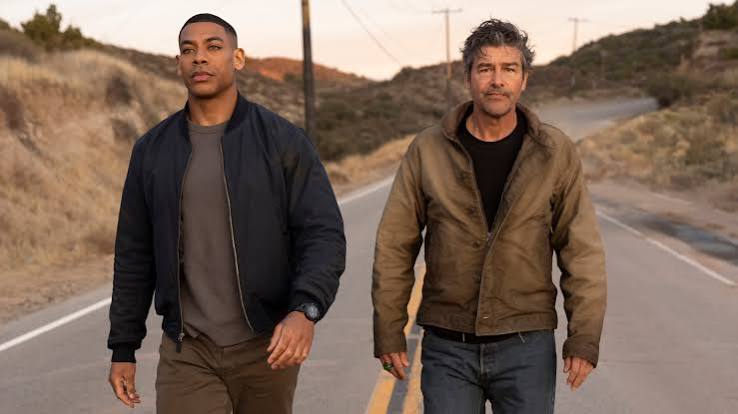
For a superhero franchise that has spent decades reaching for the stars, Lanterns takes a surprisingly down-to-earth approach. HBO Max’s new series, which premiered August 16, drops Green Lanterns Hal Jordan and John Stewart into the dusty expanses of Nebraska, where a murder mystery gives way to something even more compelling: a deeply human story about two very different men learning how to work together.
The series comes from showrunner and co-creator Chris Mundy, co-creator Tom King and executive producer/co-creator Damon Lindelof, with Kyle Chandler as veteran Lantern Hal Jordan and Aaron Pierre as John Stewart. The cast also includes Kelly Macdonald as Sheriff Kerry, Poorna Jagannathan as Zoe and Garret Dillahunt as William Macon.
At the heart of Lanterns is an unlikely partnership. Hal is older, experienced and accustomed to being the guy in charge. John is younger, disciplined and unwilling to simply accept the world—or Hal Jordan—on someone else’s terms. Their relationship provides the series with its humor, friction and emotional engine.
For Chandler, finding that dynamic was less about imposing a preconceived idea of what a Green Lantern should be and more about allowing the chemistry to develop naturally.
“The first thing that we did was to get to know each other on the set and to get to know all the other people on the set,” Chandler said during a pre-premiere media event. Working with Pierre, director James Hawes and Mundy, he said, quickly created “a very cool collaborative process” that allowed the actors to make mistakes and discover their characters together.
“It didn’t take long for Aaron and I to find a spot where, oh, okay, that’s you, that’s me, that’s my character, that’s your character,” Chandler said. “And then we started playing back and forth. And all the rest of it fell into place.”
Pierre described that process in one word: “safety.”
“We wanted to establish a safety within our partnership and dynamic,” he said, extending that philosophy to “the entire team, the entire family who were pouring themselves into this to make it the best version of itself.”
That freedom, Pierre said, allowed the two actors to experiment. “Kyle and I did a lot of falling forwards,” he joked, explaining that they were encouraged to improvise and surprise one another without derailing the story.
“They knew we were always going to get from point A to point B, but how we got there, nobody knew,” Pierre said. “They permitted us freedom and liberty to do that.”
That sense of discovery is central to the show’s larger philosophy. Lindelof, whose résumé includes Lost and Watchmen, said the idea of making Green Lantern compelling wasn’t ultimately about the mythology, the rings or the extraterrestrial elements. It was about the people wearing them.
“I think that anytime you’re working on something that isn’t original, something that you’re inheriting, you either lean in or you lean out,” Lindelof said. What attracted him to King’s original concept was that it was envisioned as a True Detective-style story set on Earth, featuring “space cops.”
But there was a more personal reason the idea resonated with him. Lindelof said he had reached a point in his own career where he was “starting to feel like it’s time for me to give up the ring, but I don’t want to let it go.”
That became a key to understanding Hal.
“Why should I care about space cops?” Lindelof asked rhetorically. “The answer is kind of embedded in what Kyle and Aaron were just talking about, which is this kind of idea of like, well, they’re human beings first before they even put on the rings.”
That grounding extends literally to the show’s setting. Rather than opening with an overwhelming parade of cosmic spectacle, Lanterns establishes itself mainly in the fictional town of Rushville, Nebraska.
Mundy, who is from Nebraska, said the series deliberately builds its world from the ground up. The first constructs created by the Lanterns are relatively mundane before the series gradually expands its visual vocabulary.
“Are you accepting this reality? Are you accepting these people as real people with this weird job of being a space cop, but they also still have to wake up as themselves?” Mundy explained.
For King, the decision to set the story in Nebraska was about scale.
“With superheroes, having sort of lived in the superhero moment for almost 25 years now of them being a pop culture, that the powers and the incredible and the amazing of it all can just be noise on top of noise,” King said. “There’s no scale.”
He compared it to Lawrence of Arabia: the desert becomes vast because there is something small against which to measure it. “To make a show where we can show why the powers are important because we build the scale of the real,” he said, Nebraska became the ideal backdrop.
The choice also has a personal dimension for King. His grandmother came from a small Nebraska town, and as a child growing up in Los Angeles, he found her stories of rural life almost otherworldly.
“She rode a horse to school and there were three people in the schoolhouse and they all knew each other,” King recalled. “And to me, that was an alien planet.”
So, in an intriguing twist, Lanterns treats rural Nebraska as its own kind of alien landscape.
The creators also wanted to make the age of their protagonist part of the story. Chandler’s Hal Jordan is not the standard youthful superhero archetype. He’s an experienced man confronting the possibility that his best days may be behind him.
“When I got this, I was like, oh wow, really? I’m going to be a superhero? Me?” Chandler joked.
But he quickly recognized the advantage of playing a hero at this stage of life.
“There are things with your older years that come to you that you get to, in a project like this, you get to use them,” he said. “There’s a lot of humor in getting older and there’s a lot of humor in this show.”
Mundy saw the age question as a natural extension of the show’s desire to treat superheroism as a real profession.
“If you’re going to take this, to Damon’s point earlier, these are people and it’s a real job, well, we’re all going to get to a point,” Mundy said. Eventually, anyone in a career has to wonder whether “it’s time for me to step aside for the next people.”
Lindelof immediately supplied the punchline: “It’s got a great 401k.”
If Hal represents experience, ego and the fear of becoming obsolete, Pierre’s John Stewart represents a different kind of emerging power. For the actor, portraying the character carries an enormous responsibility. John Stewart has been a beloved Green Lantern for decades, and Lanterns marks his first live-action incarnation.
Pierre said what drew him to Stewart was the character’s complexity and emotional honesty.
“One of my favorite things about John Stewart and how he’s detailed and how he is written and shared with audiences is the truth and the honesty that is present within him and how he is just so immensely complex,” Pierre said.
He described John as someone who can make viewers feel “seen,” “heard,” “understood,” “comprehended” and “respected.”
“The enormity of that gift is not lost on me,” Pierre said of playing the character. “It’s an immense privilege and joy to have been given the opportunity to portray him in the first live-action version.”
Pierre also sees a contradiction at the center of John: externally controlled and precise, internally turbulent.
“John to me is somebody who is a raging sea internally,” he said. “Externally he’s a gentleman, he’s precise, he’s accurate, he’s intentional, he’s clean. But internally, he’s a raging sea, he’s a tornado, he’s a volcano.”
That complexity is part of what the creators believe will distinguish Lanterns from previous attempts to bring Green Lantern to the screen.
Lindelof argued that the secret isn’t a complicated one.
“It’s all about the characters and their humanity,” he said. “If you start and approach the material from the point of— and you’re having conversations about rings and planets and aliens and all that stuff, you’re in the wrong territory.”
Instead, the writers asked: “Who are these guys? Where do they come from? What does Hal want? What does John want?”
The result, Lindelof suggested, is less a conventional buddy-cop story than a relationship drama disguised as one.
“Undergirding the tropes of a buddy cop story was this much more interesting idea, of kind of a love story and a mutual respect story,” he said.
That doesn’t mean Lanterns abandons the genre. It simply uses the genre as a delivery system for its characters. The creators cited everything from No Country for Old Men and Midnight Run to Westerns, romantic comedies and the original Green Lantern comics as influences.
Mundy said No Country for Old Men was an important reference point because of its geography and escalating sense of pressure, while Midnight Run offered a model for balancing comedy and genuine stakes.
“The banter is always funny and yet the stakes are always real,” Mundy said.
King looked back to the comic-book roots of John Stewart, particularly the work of Neal Adams and Denny O’Neil. Stewart’s refusal to simply accept the world as it is became an important part of the character’s DNA.
Lindelof, meanwhile, saw Lanterns through the prism of the Western.
“The show at times felt like Western,” he said, invoking the archetypal masculinity of classic films and the complicated relationships between fathers and sons.
“Then you layer all that stuff in and you make that the science—the genre stuff support those ideas,” Lindelof said.
That philosophy also makes room for characters who don’t wear rings.
Macdonald’s Sheriff Kerry immediately sees through Hal’s swagger. She recognizes that beneath his bravado is something more complicated.
Macdonald said Kerry “can see through him right away,” while acknowledging that Hal can see through her, too. She was attracted to the character’s “bolshie and no-nonsense” attitude—and to the chance to embrace a very different kind of superhero costume.
“I’ve got this real thing for Americana and anything vaguely cowboy,” Macdonald said. “I’ve got far too many pairs of cowboy boots in my wardrobe in Glasgow.”
Playing Kerry gave her a badge, a massive hat and bespoke cowboy boots. “It couldn’t have been better for me,” she said.
Jagannathan and Dillahunt bring another layer of mystery to the series as Zoe and William Macon. Jagannathan described Lanterns as both a whodunit and “a very profound dissertation on power.”
For Zoe, the arrival of John immediately creates a point of connection. She and John are among the few people of color in a predominantly white town, Jagannathan noted, creating “an instant connection, instant curiosity.”
Dillahunt praised the writing and the unusual power dynamics between their characters, while also predicting a major future for Pierre’s John Stewart.
“I think you’re going to see this face for John Stewart for years to come,” Dillahunt said. “It’s just I think they were waiting, I think Green Lantern was waiting for him.”
Perhaps most importantly, Lanterns isn’t being conceived as an endless superhero treadmill.
Asked whether the creators know where the story is going, Lindelof pointed to his experience on Lost and Watchmen. The goal, he said, is to tell a complete story while leaving viewers hungry for more.
Mundy’s vision, Lindelof explained, was to resolve both the central mystery and the relationship between Hal and John while still making audiences want to return to that world.
“We’re going to a mystery, and then, more importantly, we’re going to have a relationship story between these two guys that feels resolved at the end of the story that we’re telling,” Lindelof said, “but we want the audience to be really hungry for more when it ends.”
His verdict on the finished series was simple: “It feels like it was a really good meal but a couple of hours after you’ve consumed it, you’re going to say, I think I want to spend some more time in that world.”
That may ultimately be Lanterns‘ biggest gamble—and its biggest strength. Instead of trying to make Green Lantern bigger, louder and more cosmic, HBO Max has made the unusual choice to make it smaller first.
Two men. One dusty town. A murder mystery. A complicated partnership.
Then, eventually, the rings.
As Chandler put it when asked about the show’s influences and secret sauce, it all comes down to “really good storytelling.”
“Good people in the writers’ room and all that,” he added. “They mixed up a good group.”