There are wildlife documentaries that educate you about animals, and then there are wildlife documentaries that make you emotionally invest in one.
National Geographic’s Lion does the latter — spectacularly.
The four-part series follows Kio, a lion born in Kenya’s Maasai Mara, from a vulnerable little cub into a powerful young male fighting for the chance to establish his own kingdom. Filmed over more than four years and nearly 1,400 days in the field, Lion accomplishes something extraordinarily difficult: It captures the life of a wild lion as an unfolding character-driven drama rather than simply a collection of spectacular animal footage.
And yes, there is an obvious comparison.
Kio is basically the real-life Simba.
That isn’t accidental. The series is executive produced by Jon Favreau, who directed the photorealistic 2019 version of The Lion King, and the score comes from Hans Zimmer, who also composed the music for that beloved Disney classic. O.J. Lynch, who performed Mufasa in The Lion King stage production, provides the narration.
Yet Lion is considerably more fascinating than simply being The Lion King without the singing.
Because Kio isn’t a fictional character.
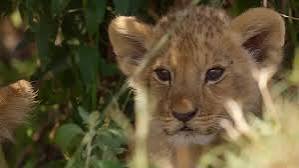
When Kio first appears, he is exactly the sort of creature that makes even hardened wildlife viewers reach for the remote to get a closer look.
He’s tiny, curious and completely dependent on his mother, Summer. The enormous Maasai Mara surrounding him is both playground and minefield. Zebras and giraffes tower over him. Elephants can send him scrambling for safety. Hyenas are a threat. Buffalo can be lethal. And other lions can pose perhaps the greatest danger of all.
The series immediately establishes the brutal mathematics of life on the savanna: Being adorable is not a survival strategy.
Kio is born into a large pride, but his journey is anything but guaranteed. In fact, the production’s four-year commitment makes the story all the more remarkable. Of roughly 20 cubs born into the pride during the filming period, Kio was the only one who survived.
Every time Kio wanders away from his mother, the stakes feel enormous.
Every time he encounters another animal, there is genuine suspense.
And when the older males eventually force Kio and his brothers away from the pride, Lion shifts from a story about childhood into something much closer to a survival epic.
The four episodes are structured almost like a traditional dramatic series.
The first, “A Prince Is Born,” introduces Kio and his family and asks the tantalizing question: Could this tiny cub someday become king?
The second, “A Band of Brothers,” expands the story into Kio’s relationship with his older brothers and the dangers confronting young males as they grow.
The third, “The Greatest Sacrifice,” brings tragedy and tests Kio’s courage.
And the finale, “To Be King,” finds Kio and his brothers far from home, attempting to survive in territory controlled by rival males while Kio confronts the possibility of claiming a kingdom of his own.
That structure is one of Lion‘s greatest strengths.
Rather than presenting the usual wildlife-documentary formula — predator hunts prey, animals mate, cubs are born, seasons change — the filmmakers have constructed an actual narrative arc.
There is a beginning. There are setbacks.There is exile. There is loss and the tantalizing possibility of triumph. The difference, of course, is that nobody wrote the ending.
One of the most interesting aspects of Lion is that while the series is ostensibly about Kio’s journey to becoming king, the real story is also about the female lions who make that journey possible.
Summer and the other lionesses aren’t simply supporting characters in Kio’s story. They are the pride’s foundation — hunting, protecting cubs, maintaining social bonds and navigating the constant threats surrounding them.
The traditional image of the male lion as undisputed ruler of the jungle doesn’t quite capture how lion society actually works. The males may ultimately benefit from holding territory and access to females, but the pride is dependent upon cooperation, particularly among the lionesses.
The sheer amount of work behind Lion is almost as impressive as what appears on screen.
The production spent nearly 1,400 filming days across 52 shoots, making it the first natural-history production to document a lion’s journey from vulnerable cub through adulthood. Local Kenyan filmmakers were an important part of the production, and the crew used long lenses, low-mounted cameras and drones to get remarkably intimate perspectives without interfering with the animals.
That intimacy is extraordinary, even including flies dangerously close to crawling across Kio’s eyeballs..
The cameras aren’t merely observing lions from a distance. They are frequently positioned close enough to capture tiny behavioral details — a look between siblings, the protective attention of a mother, a young male testing his strength.
The aerial photography is equally spectacular, transforming the Maasai Mara into a vast natural theater.
And then there is Zimmer’s music, which beautiful, sweeping and sometimes almost shamelessly emotional.
Watching a lion cub walk alone across an enormous African landscape practically demands a big score.
Favreau’s involvement is perhaps the cleverest piece of the production.
After spending years creating digital lions for The Lion King, he turned his cameras toward the real thing.
The result is a fascinating contrast. In the Disney movie, Favreau could control every frame, every movement and every emotional beat. In Lion, nature is in charge.
As Favreau has explained, the filmmakers initially followed about 50 lions and multiple storylines before looking back over the accumulated footage and discovering that Kio was the character whose story demanded to be told.
And because the filmmakers couldn’t know whether he would survive, much less become the animal they hoped he would, the series carries an authenticity that no scripted adventure could duplicate.
The comparison to The Lion King is inevitable, but Lion ultimately works because it goes beyond that familiar mythology.
Simba’s journey was about destiny.
Kio’s is about survival.
Simba had a father who could tell him he was destined to become king.
Kio has to figure it out himself.
There are no magic clouds, no talking birds and certainly no “Hakuna Matata.” There is hunger, territorial warfare, predators, rival males, human encroachment and the constant possibility that one bad decision could end everything.
That makes Kio’s eventual transformation all the more satisfying.
You don’t simply watch him grow physically.
You watch him learn. You watch a creature that once needed his mother begin to understand the responsibilities and dangers of being an adult male. And you start rooting for him.
There are moments when Lion pushes so hard toward drama that traditionalists might argue it is becoming too much like a scripted television series.
The narration can be portentous. Zimmer’s score occasionally tells us how we’re supposed to feel. The editing sometimes turns animal behavior into something resembling a three-act screenplay.
Yet because it’s all read, that makes the emotional manipulation surprisingly easy to forgive.
Indeed, Lion demonstrates why natural-history filmmaking has increasingly become one of television’s great forms of storytelling. The animals don’t need dialogue. They don’t need human voices. They don’t even need to understand that they’re being filmed.
They simply need to live. The filmmakers’ job is to be patient enough to capture it.
Lion is the powerful payoff for that patience.