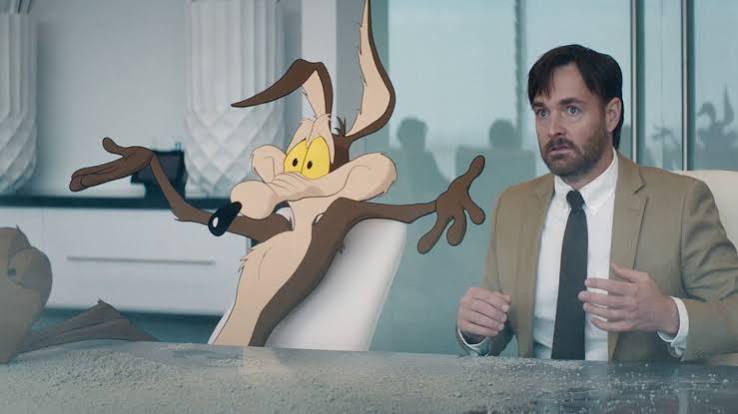
For a movie about a cartoon character who spends his life falling off cliffs, getting blown up, flattened and otherwise humiliated by his own ill-fated schemes, Coyote vs. Acme has had a remarkably similar journey.
The live-action/animated comedy was completed in 2022, only to become one of Hollywood’s most notorious casualties of corporate accounting. Warner Bros. decided in 2023 to shelve the roughly $70 million production and take a tax write-off rather than release it. The decision generated an uproar from filmmakers, actors and fans who couldn’t understand why a finished movie — particularly one built around some of the most recognizable characters in American animation — would simply disappear.
But Wile E. Coyote has never been particularly good at staying down.
After years in limbo, Coyote vs. Acme was rescued by independent distributor Ketchup Entertainment, which acquired the film for a reported $50 million and has finally put it into theaters nationwide Friday, Aug. 28.
The irony is almost too perfect: A movie about a persistent underdog taking on an enormous corporation nearly became a victim of the very kind of corporate decision-making that its story lampoons.
And now the movie Warner Bros. didn’t want audiences to see is, at long last, playing on the big screen.
The premise sounds like one of those jokes that should have remained a joke — which is precisely why it works.
For decades, Wile E. Coyote has pursued the Road Runner with increasingly elaborate Acme contraptions: rockets, explosives, catapults, traps and gadgets that almost invariably turn against him. In Coyote vs. Acme, he finally decides that perhaps the problem isn’t him.
It’s Acme.
After yet another disastrous attempt to catch his nemesis, Wile E. Coyote decides to sue the company whose products have repeatedly — and spectacularly — failed him. The idea originated with writer Ian Frazier’s satirical 1990 New Yorker piece, which imagined the Coyote bringing a legal case against Acme. Screenwriter Samy Burch, working from a story by Burch, James Gunn and Jeremy Slater, transformed that joke into a feature-length courtroom comedy.
Enter Will Forte as Kevin Avery, a down-on-his-luck personal injury lawyer in Albuqueruqe who takes on the seemingly ridiculous case. Kevin quickly discovers that defending a cartoon coyote against a gigantic corporation is considerably more complicated than it sounds.
The case also becomes personal. John Cena plays Acme’s formidable corporate attorney, who happens to be Kevin’s boss, turning the legal battle into an increasingly awkward professional and personal confrontation. Lana Condor plays Kevin’s niece Paige, who becomes an important part of the fight for justice.
What begins as a goofy lawsuit consequently develops into something surprisingly recognizable: an ordinary underdog taking on a corporation with seemingly unlimited resources.
Except the plaintiff is a cartoon coyote.
Forte, a former SNL star whose career has frequently involved balancing absurdity with genuine emotion, is ideally suited to the role of Kevin.
The actor has spoken openly about the emotional roller coaster of making the movie, watching it disappear and then learning that audiences would finally get to see it. He has described feeling pride in the finished film followed by the disappointment of believing it might never be released.
That history gives Forte’s performance an additional layer of accidental meta-comedy. His character is fighting to keep his client’s case alive at exactly the same time that the movie itself was fighting to stay alive.
Cena, meanwhile, gets to play against his increasingly familiar heroic persona. As Acme’s slick corporate lawyer, he is the polished, intimidating face of an organization that has absolutely no intention of accepting responsibility for the havoc its products have caused.
Cena has taken a somewhat different perspective on the film’s troubled history than Forte, emphasizing that actors ultimately turn their work over to the people who finance and distribute it. But he has also expressed appreciation for the colleagues and creative experience that came from making the movie — and gratitude to the audience that refused to let it disappear.
Of course, the movie belongs to Wile E. Coyote.
The character has always been one of the strangest and most enduring figures in the Looney Tunes universe: a supposedly brilliant predator whose elaborate plans invariably collapse under the weight of his own ambition. He rarely speaks in the classic shorts, making his determination, desperation and increasingly bewildered expressions do the work.
Here, that silent slapstick icon becomes the emotional center of a feature-length story.
And there is, naturally, one character who remains at the heart of his obsession: Road Runner.
Their relationship is one of animation’s great comic equations. Road Runner is speed, confidence and effortless escape. Wile E. is planning, persistence and spectacular failure. The film doesn’t abandon that history; it turns it into the motivation for Coyote’s legal crusade.
The world around them is populated by an expanded roster of Looney Tunes favorites, including Bugs Bunny, Daffy Duck and other familiar characters.
Bugs, in particular, gets a role that is more integral to the plot than a simple cameo, while characters such as Daffy Duck, Porky Pig, Foghorn Leghorn, Tweety, the Tasmanian Devil and Elmer Fudd help establish the movie’s peculiar universe in which humans and cartoons coexist.
That mixture of live actors and animated characters inevitably recalls Who Framed Roger Rabbit, although Coyote vs. Acme has a very different tone. The cartoons aren’t merely visitors from another dimension; they are part of the everyday world.
The most extraordinary part of Coyote vs. Acme may ultimately be what happened outside the movie.
Warner Bros.’ decision to shelve the finished film was part of a broader period of financial restructuring at the studio, during which several completed or nearly completed projects were abandoned rather than released. Batgirl became the most infamous example, but Coyote vs. Acme became particularly frustrating because the film had already been made and had reportedly generated encouraging reactions in test screenings.
The backlash was immediate. Fans demanded its release, while people involved in the production and across the entertainment business objected to the idea that a completed work could simply vanish for accounting purposes.
Eventually, Warner Bros. reversed course enough to allow the film to be sold.
That is where Ketchup Entertainment entered the story.
The independent distributor, which had also acquired the animated Looney Tunes feature The Day the Earth Blew Up, stepped in and gave Coyote vs. Acme its second life.
The result is one of the more unusual comeback stories in recent Hollywood history: a major-studio production that became an abandoned asset, only to be transformed into an independent theatrical release whose very existence became part of its marketing.
The promotional campaign has even leaned into the controversy, effectively turning Acme into a stand-in for the studio that tried to bury the movie.
There is something fitting about all of this.
Wile E. Coyote is the ultimate Hollywood underdog. He repeatedly devises elaborate plans, suffers catastrophic setbacks and somehow wakes up the next morning ready to try again.
Coyote vs. Acme did essentially the same thing.
It was conceived as a joke, developed for years, filmed, completed and shelved. It appeared destined to become another Hollywood movie that audiences would never see. Instead, fans kept asking questions, the filmmakers kept fighting for it and Ketchup Entertainment eventually gave it a theatrical home.
So now Wile E. Coyote gets his day in court — and his day in theaters.