Tom Cruise has spent much of his career proving that audiences will follow him just about anywhere. Hang from the side of a mountain? They’re there. Strap yourself to a motorcycle and launch off a cliff? Absolutely. Fly a fighter jet? Blockbuster.
But apparently there is one place even Tom Cruise can’t guarantee an audience will follow him: the bizarre, darkly comic world of Alejandro González Iñárritu’s Digger.
The new film opened this weekend and promptly cratered at the box office, taking in approximately $8 million domestically and finishing in fifth place. Worldwide, the movie has grossed about $20 million against a production budget reported at roughly $125 million. For Cruise, whose recent films have generally been major theatrical events, it is a particularly rough opening.
And yet Digger is hardly a conventional Hollywood failure. In fact, its biggest problem may be that it is anything but conventional.
Cruise has teamed with one of contemporary cinema’s most uncompromising filmmakers to make a strange, ambitious and deliberately uncomfortable satire about greed, climate catastrophe, political incompetence and the human tendency to laugh while the world burns.
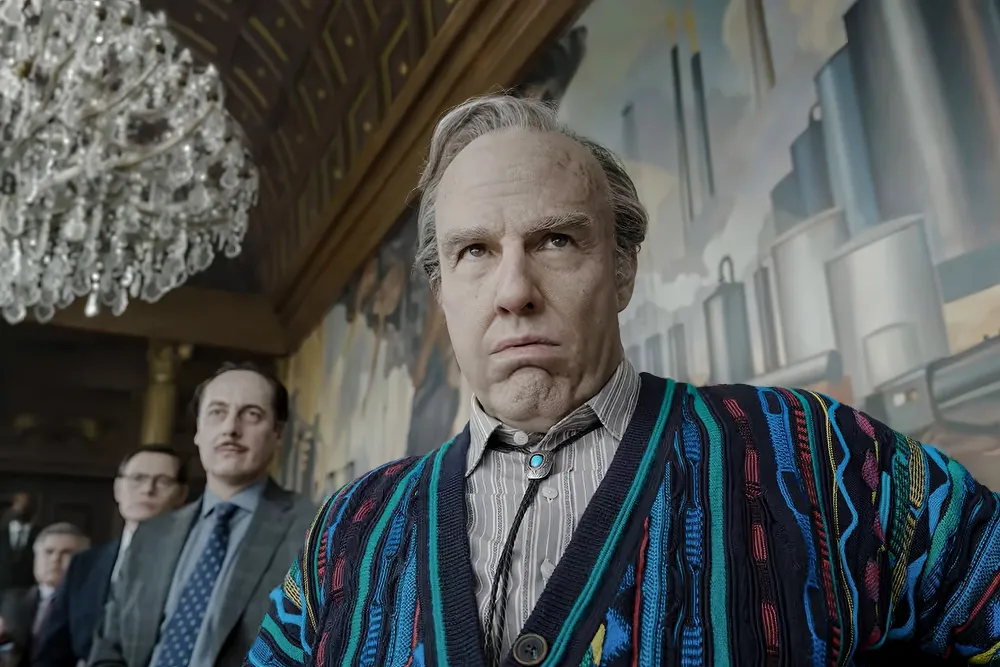
The global superstar plays Digger Rockwell, an obscenely wealthy Texas oil magnate who has accumulated enormous power and influence while drilling wherever he pleases. He is the kind of larger-than-life industrialist who seems to believe that the planet exists primarily as a resource—and that anyone who disagrees simply needs to be talked over.
Then his business helps trigger an environmental catastrophe.
A massive ice shelf breaks away from Greenland, setting off a chain reaction that threatens to send an enormous wall of ice toward Norway and create a global disaster. When scientist Dr. Ganesh, played by Riz Ahmed, attempts to explain the seriousness of the situation, Digger responds in the only way a man accustomed to getting his way knows how: by taking control.
He summons the president, played by John Goodman, and a collection of government officials and advisers for an emergency meeting. But rather than becoming a sober disaster thriller about saving the planet, Digger turns increasingly absurd as its characters attempt to protect themselves, their reputations and their interests.
The president is less concerned with solving the crisis than with surviving it politically. Digger is convinced that his money, power and sheer force of personality can somehow overcome the laws of nature. And everyone around them seems to be participating in a giant exercise in denial.
That is where Iñárritu comes in.
The Mexican filmmaker behind Amores Perros, 21 Grams, Babel, Birdman and The Revenant has never been particularly interested in making movies that simply behave themselves.
His career has been built on ambitious filmmaking experiments and stories populated by damaged, obsessive or desperate people whose lives collide in increasingly complicated ways. Amores Perros announced him as a major international filmmaker with its fractured, interlocking narrative. 21 Grams and Babel continued his fascination with lives intersecting across seemingly unrelated circumstances.
Then came Birdman, his delirious backstage comedy about an actor trying to mount a Broadway play while battling his ego, his past and his own insecurities. The film won Iñárritu the Academy Award for Best Director, and he followed it by winning again for The Revenant, the brutal frontier epic starring Leonardo DiCaprio.
Two consecutive directing Oscars established Iñárritu as one of Hollywood’s most formidable filmmakers.
But Digger is arguably an even stranger proposition.
The movie has the scale of a major studio production but the personality of an art-house provocation. It was shot entirely in VistaVision, with Oscar-winning cinematographer Emmanuel Lubezki behind the camera and Oscar-winning production designer Dennis Gassner creating the increasingly elaborate world around Digger.
For perhaps the first time in years, the actor isn’t playing the impossibly fit, impossibly competent Tom Cruise version of Tom Cruise.
He is buried beneath prosthetics, sporting a bulky body, thinning gray hair and a pronounced Texas drawl. Digger is grotesque, arrogant, funny, obnoxious and occasionally repulsive. It is a performance designed to make audiences forget that the man underneath the makeup is one of the world’s biggest movie stars.
And Cruise appears to be having a very good time doing it, as do his supporting cast.
Ahmed brings intelligence and moral urgency to Dr. Ganesh, the scientist who understands just how serious Digger’s environmental recklessness has become. Goodman gets to play the president, giving the movie one of its most potent comic weapons by turning the Oval Office into another arena for Iñárritu’s absurdist vision.
Sandra Hüller, fresh from her acclaimed work in Anatomy of a Fall and The Zone of Interest, plays Digger’s half-sister and business partner. Michael Stuhlbarg appears as the vice president, while Jesse Plemons has a key role as Kenny. The ensemble also includes Robert John Burke, Emma D’Arcy, Burn Gorman and Sophie Wilde.
The sheer pedigree of the cast makes the movie’s box-office performance even more curious.
This should, on paper, have been irresistible.
Tom Cruise.
The director of Birdman and The Revenant.
Riz Ahmed.
John Goodman.
Sandra Hüller.
Jesse Plemons.
Emmanuel Lubezki.
Dennis Gassner.
A $125 million production.
Instead, Digger walked into theaters facing decidedly mixed reactions. Some critics have admired its audacity, its visual imagination and Cruise’s willingness to go completely against type. Others have found the satire heavy-handed and the movie’s increasingly unconventional structure frustrating.
That split may be the real story.
There is something almost perversely appropriate about a film about a powerful man convinced he can control everything arriving in theaters and discovering that even Tom Cruise can’t control what audiences want.
Cruise has spent the last decade becoming the industry’s ultimate theatrical reliability machine. Top Gun: Maverick turned into a cultural phenomenon. The Mission: Impossible franchise has made his name synonymous with event cinema. Audiences know exactly what they are buying when they see Cruise’s face above a movie title.
Digger deliberately breaks that contract.
There are no spectacular Cruise stunts designed to make viewers gasp. There is no familiar franchise. There isn’t even an uncomplicated hero.
Instead, Iñárritu gives audiences a grotesque oil billionaire, an environmental catastrophe and a deliberately theatrical satire about humanity’s inability to take its own impending problems seriously.
It is closer in spirit to the dark political absurdism of Stanley Kubrick’s Dr. Strangelove than anything Cruise has done in years.
And that may ultimately make Digger more interesting than its box-office numbers suggest.
The movie took nearly a decade to reach the screen, with Iñárritu beginning work on it before the pandemic. The director has assembled an enormous technical team, including frequent collaborator Lubezki, editor Stephen Mirrione, costume designer Jacqueline West and makeup artist Kazu Hiro.
Whether Digger eventually becomes one of those expensive theatrical misfires that develops a second life on streaming, or simply becomes an intriguing footnote in Cruise’s extraordinary career, remains to be seen.
But there is something undeniably refreshing about watching one of Hollywood’s most powerful movie stars spend $125 million making something this strange.
Cruise could have made another safe choice.
Instead, he made Digger.
And while audiences may not have dug it this weekend, the fact that a movie this peculiar exists at all is something worth celebrating.