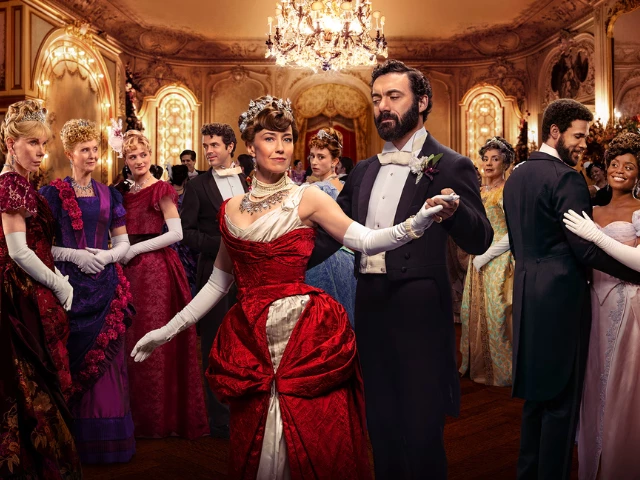
Tensions are rising and love is blossoming as Season 3 of The Gilded Age nears its midpoint.
Will Gladys Russell be forced to marry the Duke to increase her family’s social standing–or will she be able to follow her own heart?
Will Marian Brook and Larry Russell be able to openly proclaim their love for each other instead of clandestinely kissing and living with the fear of being found out?
Will sisters Agnes van Rhijn and Ada Brook ever quit bickering now that Ada has surpassed Agnes as mistress of the house as the widow Mrs.Forte?
Will the individual ambitions of George and Bertha Russell drive a wedge between the couple and pummel their social standing?
Will Peggy Scott be able to win acceptance by the family of her new boyfriend, Dr. William Kirkland?
The answers to these and many other questions keep us glued to HBO on Sunday nights.
Prior to the premiere of the new season, creator Julian Fellowes, co-writer and executive producer Sonja Warfield and key cast members including Christine Baranski, Carrie Coon, Cynthia Nixon, Morgan Spector, Harry Richardson, Louisa Jacobson, Denée Benton and Taissa Farmiga sat down with reporters to dissect some of the overall themes and their characters’ motivations.
The huge shift in the dynamic between Baranski’s Agnes and Nixon’s Ada lays bare the power of wealth, wealth that Ada inherited from the ever-so-brief marriage before her husband died. The servants are confused, and aren’t afraid to show it, by wondering exactly who is in charge now and whose orders they should follow, as it’s always been the instruction of the indomitable Agnes.
Things really get uncomfortable when Ada tries to get all of the staff to sign on to a temperance agreement in especially cringe-worthy ways. No one really wants to give up their alcohol, especially not Agnes.
“The English are very given to believing that the loss of money hasn’t affected anything. Of course, it’s bollocks now, and it was bollocks then. Nevertheless, they deceive themselves more, I think, than the Americans,” Fellowes said. “And on the whole, the Americans are a more realistic nation about how it is now. And that’s really what we’re seeing with these two sisters and the others–they understand the change that has taken place, but they don’t feel it’s their business to make the change obvious. It has to be between the sisters that they have to come to terms with what is different.”
We will see if that ever happens. It’s hard to imagine Agnes as second fiddle, or someone’s +1, but she’s already mused about living out her life in Newport with Aurora, a woman disgraced by her husband leaving her in an age when divorce was a social death sentence.
“I mean, it’s not good news for Agnes, but it’s great news for Christine and for Christine and Cynthia for the number one, the boss, the authority figure, the person who has assumed a certain place in the household and society,” Baranski said. “When the royalty falls off the throne, it makes for a good story-making and it also makes for delicious comic moments. We’ve had a lot of fun with it.”
The relationship between Bertha and George Russell (Coon and Spector) it is not so much fun. They are being driven apart by Bertha’s machinations regarding their daughter Gladys’ potential marriage to a duke, which in Bertha’s estimation, would make her one of the most powerful and admired women in the world. But Gladys has her heart set on another man and her father could be on board with that, or he could be planning his own financial subterfuge regarding his own daughter.
“George doesn’t understand our instinct for survival, which is, in this case, through marriage, and that Bertha really believes what she’s doing is an existential question,” said Coon. “She wants her daughter to be safe. She also wants her to be fulfilled and have a sense of purpose, because I think Bertha knows what it feels to have that capacity thwarted, she wants her daughter, she’s hungry for her daughter to have a kind of power she didn’t have.”
But only a fool would underestimate Bertha’s power.
“I don’t think George can really let go of the fact that there’s an implicit critique of his own position in society that Bertha is making, you know, if you have to marry an English aristocrat to really feel like you’ve arrived, then the sort of status that George has built for himself isn’t enough,” Spector said about his character. “And I think that that’s another source of sort of tension and unspoken friction between them.”
Speaking of friction, Dr. Kirkland’s mom, a new character this season played by Phylicia Rashad, is none too pleased with the Scott family, thinking they are well beneath them in social standing.
While many have remarked on the show’s welcome depiction of Black society before the turn of the twentieth century, it is clear that there are many strata among the educated class.
“I think that Julian planting the seed of this Black elite world in our show and it getting to blossom into this garden with all of us watering it is just astounding to me and people are learning history, and I’m learning history,” said Benton, who portrays Peggy. “I feel like I’m getting to embody something really important and I would want to know more and more and see exactly what the Scotts go on to do or what the Kirkland’s go on do.”
(The Gilded Age runs Sunday nights on HBO Max.)