There was a certain irony to Fritz Coleman hosting the 13th annual Location Managers Guild International Awards Saturday night at the Eli and Edythe Broad Stage in Santa Monica.
Coleman spent 40 years working at the same location — NBC Los Angeles — but on this night, the former KNBC weatherman was celebrating the people whose job it is to constantly search for the next great place to tell a story.
Before a receptive crowd of roughly 400 location professionals, filmmakers, industry executives and press from around the world, Coleman paid tribute to what he called one of the entertainment industry’s most important and least recognized crafts.
Location managers, he noted, do far more than find a building, street, desert or mountain that looks good on camera. They negotiate access, deal with communities and local authorities, navigate logistics and help filmmakers turn real-world places into essential components of a story.
And despite the industry’s increasing reliance on virtual production and digital technology, Coleman stressed that technology isn’t going to eliminate the need for the professionals who find the real places.
That message was particularly appropriate for an evening in which actual locations were, for once, the stars.
The LMGI awards honor outstanding use of filming locations in motion pictures, television, commercials and other productions. This year’s winners underscored just how dramatically a location can shape a project, from the California landscapes of Paul Thomas Anderson’s “One Battle After Another” to the New York and Tokyo settings of “Marty Supreme” and the distinctive Southwestern terrain of Apple TV+’s “Pluribus.”
The contemporary feature award went to Warner Bros.’ “One Battle After Another,” whose production utilized locations across California’s Humboldt County, Sacramento, Stockton, Eureka, Arcata and San Diego, as well as El Paso, Texas. The period feature prize went to A24’s “Marty Supreme,” filmed in New York City and the surrounding region, New Jersey and Tokyo.
On the television side, “Pluribus” took the contemporary series award, with its locations spanning Albuquerque, New Mexico, Montana, Nevada and Spain. “Fallout” Season 2 won for period television after shooting in California’s Dumont Dunes, the Mojave Desert, Antelope Valley and Santa Clarita, while Netflix’s “Black Rabbit” was honored in the anthology/movie/limited-series category for its New York locations, including Brooklyn and Manhattan.
The awards also went beyond scripted entertainment. Toyota Trucks’ “They Don’t Read Reviews” won for Outstanding Locations in a Commercial, while the Humboldt-Del Norte Film Commission was recognized for its work on “One Battle After Another.”
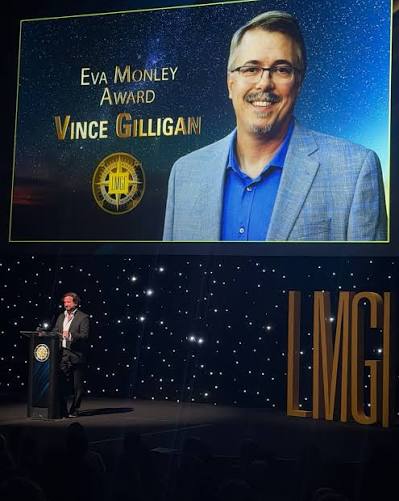
One of the evening’s biggest moments came when four-time Emmy-winning writer, director and executive producer Vince Gilligan received the Eva Monley Award, named for the pioneering location scout and manager.
Gilligan’s résumé — “The X-Files,” “Breaking Bad,” “Better Call Saul,” “El Camino” and “Pluribus” — is unusually intertwined with the power of place. “Breaking Bad,” “Better Call Saul” and “Pluribus” in particular have made extensive use of New Mexico, transforming Albuquerque and the surrounding landscape into something approaching a character in their own right.
For Gilligan, location has been more than a production necessity. The barren landscapes, distinctive architecture and wide-open spaces of New Mexico have helped establish the visual language of the worlds he has created.
“Pluribus” has taken that philosophy even further, expanding beyond New Mexico to Montana, Nevada and Spain. Location Manager Christian Díaz de Bedoya, who has collaborated with Gilligan on several major productions, presented the Eva Monley Award. The two have spent years traveling thousands of miles together in search of locations capable of becoming indelible parts of Gilligan’s storytelling.
The production of “Pluribus” even required the construction of a custom seven-house cul-de-sac, while Díaz de Bedoya helped incorporate Paraguayan cultural details into the series — a reminder that location management can involve everything from finding an existing landscape to effectively creating a community from the ground up.
Gilligan’s recognition was therefore particularly fitting for an organization devoted to the proposition that where a story happens can be just as important as what happens.
The Environmental Media Association received the Humanitarian Award for its work advancing sustainable production practices throughout the film and television industries.
EMA has become a global advocate for getting productions — and the audiences watching them — to think more seriously about their environmental impact. CEO Debbie Levin accepted the award, which was presented by actress Wendie Malick.
The LMGI’s own commitment to sustainability was also on display. The awards received EMA Green Seal Certification for environmentally responsible production practices, with the event featuring a “Green Carpet” designed to recognize the environmental efforts of the production and the creative contributions of location professionals.
Lightship, the electric mobility and energy company, also showcased its PowerSled mobile energy platform and solar-powered trailer, offering a glimpse at how cleaner and quieter production technology can be incorporated into location work.
The evening’s Lifetime Achievement Award went to veteran location manager Mike Fantasia, whose route into Hollywood was anything but conventional.
Fantasia spent a decade with the U.S. Forest Service, where he developed an unusually intimate knowledge of ecosystems, geography and geology. That expertise eventually proved invaluable in filmmaking, where understanding terrain can mean the difference between merely identifying a beautiful location and knowing whether a production can actually function there.
His film career began with Steven Spielberg’s 1989 film “Always,” shot in Libby, Montana. More than three decades later, his credits include such productions as “Top Gun: Maverick,” “Killers of the Flower Moon,” “Spider-Man: Homecoming” and “Indiana Jones and the Kingdom of the Crystal Skull.”
Fantasia was also a founding member of LMGI and helped turn the organization into a significant advocate for location professionals. He served nine years on its board of directors, including four years as president.
Production designer Jeannine Oppewall presented Fantasia with the award, recognizing a career that demonstrates how expertise accumulated outside Hollywood can become a major asset inside it.
The Association of Film Commissioners International received the evening’s Trailblazer Award for more than 50 years of leadership advancing film commissions around the world.
Film commissions can be critical to productions deciding where to shoot, helping filmmakers navigate permits, locations, local regulations, incentives and relationships with communities. Claire Brooks, AFCI’s executive director, accepted the award from MaryAnn Hughes, vice president of Production & Investment Planning at The Walt Disney Company and an AFCI Advisory Board member.
That relationship was also reflected in the Humboldt-Del Norte Film Commission’s win for its work on “One Battle After Another.”
Taken together, the awards made a broader point about the economics and culture of production: the locations department isn’t simply there to make a movie look authentic. Productions bring spending, jobs and attention to the places where they shoot, while successful films and television shows can subsequently turn those locations into tourist destinations.
The LMGI noted that authentic locations can function as characters in storytelling, inspire so-called “set-jetting” by fans and contribute to local economies through production spending and tourism.
The 13th LMGI Awards thus celebrated a corner of the entertainment business that audiences rarely think about when watching a finished film or series. Viewers may remember Walter White’s Albuquerque, the sprawling landscapes of “Pluribus” or the streets of New York in “Marty Supreme.” What they don’t necessarily see is the army of professionals who found those places, secured them, protected them and made it possible for filmmakers to transform them into worlds.
For one night in Santa Monica, the people behind those worlds finally got their close-up.