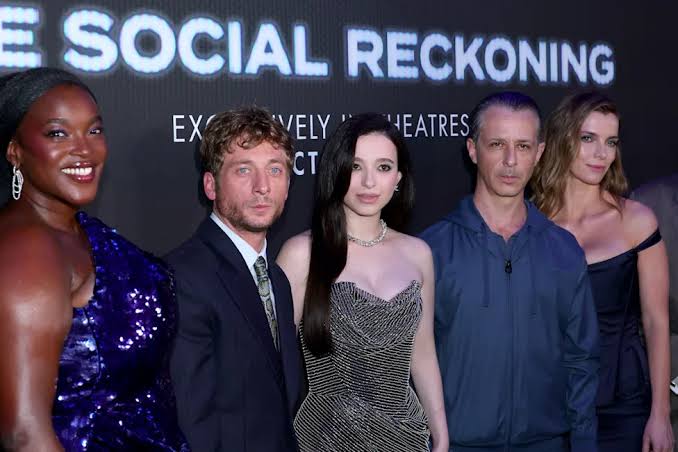
Fifteen years after The Social Network turned the creation of Facebook into one of Hollywood’s most compelling tales of ambition, betrayal and billion-dollar egos, writer-director Aaron Sorkin is back with The Social Reckoning, a far more troubling chapter in the story of the social media giant. Opening in theaters today, October 9, the film shifts the focus from the audacious beginnings of Mark Zuckerberg’s empire to the potentially devastating consequences of what that empire has become.
This time, the question isn’t who gets credit for inventing Facebook. It’s what happens when the company behind one of the world’s most influential platforms discovers that its own internal research may reveal just how much damage it is doing.
Inspired by real events, The Social Reckoning follows Frances Haugen, the former Facebook engineer who became one of the company’s most consequential whistleblowers, and Jeff Horwitz, the Wall Street Journal investigative reporter who helped bring her revelations to the public. Together, they expose internal documents suggesting that Facebook knew far more about the harmful effects of its products than it had acknowledged publicly.
It’s a natural subject for Sorkin, whose gift for rapid-fire dialogue, high-stakes confrontations and morally complicated institutions helped make The Social Network a modern classic. But while the earlier film captured the intoxicating thrill of a technological revolution, its companion piece takes a decidedly darker view of what happens when that revolution goes largely unchecked.
The result is an ambitious, occasionally gripping drama that raises important questions about corporate responsibility, misinformation and the price society pays for a business model built around keeping people online. Yet the film also struggles to turn a story whose implications are enormous into a consistently engaging cinematic experience.
One of the film’s biggest assets is its cast, which brings together several of today’s most compelling performers to portray people who found themselves at the center of a defining moment in the technology industry.
Mikey Madison, fresh off her Oscar-winning performance in Anora, takes on Haugen, the data engineer who decided that remaining silent was no longer an option. In 2021, Haugen came forward with internal Facebook documents that helped fuel a Wall Street Journal investigative series examining the company’s handling of misinformation, harassment, political content and research into Instagram’s effects on teenage girls.
Haugen’s disclosures also raised questions about Facebook’s content-ranking algorithms and whether the company’s efforts to maximize engagement could amplify anger and divisive material. Her decision to go public culminated in congressional testimony that put the company’s internal deliberations under a harsh spotlight.
Madison has the difficult task of making a whistleblower’s story dramatically compelling without losing sight of the real person behind the headlines. Haugen was neither a conventional crusader nor an outsider looking in. She was an employee who had believed in the platform’s potential and ultimately came to believe that the public deserved to know what the company’s own research revealed.
That tension gives the story its most intriguing human dimension: the uneasy realization that exposing wrongdoing can mean turning against the very institution one once hoped to improve.
Jeremy Allen White, meanwhile, plays Horwitz, the journalist whose reporting helped turn Haugen’s evidence into a major public reckoning. Best known for his emotionally raw work in The Bear, White brings a different sensibility to the role of an investigative reporter navigating the complicated process of corroborating sensitive information, protecting a source and getting the story right.
Horwitz may not be as recognizable a public figure as Zuckerberg, but his role underscores an essential point: whistleblowers need journalists who can turn private revelations into a documented public record. The partnership between Haugen and Horwitz provides the film with its investigative engine.
The third major player is, of course, Zuckerberg himself, portrayed by Jeremy Strong. Taking over a role previously played by Jesse Eisenberg, Strong faces the challenge of depicting a much older, wealthier and more powerful version of the Facebook founder without simply revisiting the earlier performance, the version after his hoodie-wearing days.
Strong approaches Zuckerberg as a study in control, presenting a corporate leader who must navigate mounting scrutiny while protecting the company he built. The actor reportedly remained in character on set, even adopting Zuckerberg’s voice and mannerisms between takes, a commitment that reflects his famously immersive approach to performance.
The casting makes for an interesting contrast. Eisenberg’s Zuckerberg was a restless young entrepreneur, consumed by ambition and the desire to prove himself. Strong’s version is the established billionaire, presiding over an empire whose influence extends far beyond the college campuses where Facebook began. The character has moved from the margins of the social scene to the center of global power, but the question of how he understands his responsibilities remains.
The ensemble is rounded out by Wunmi Mosaku, Betty Gilpin, Billy Magnussen and comedian Bill Burr, among others. Their presence helps populate the corporate, journalistic and political environments through which the story moves.
Mosaku and Burr are particularly useful in a narrative that needs to dramatize the machinery behind the headlines. The film’s corporate scenes, including Zuckerberg’s preparations for congressional scrutiny, offer glimpses of an organization attempting to manage a crisis while protecting its leadership and reputation.
Burr brings his distinctive edge to the proceedings as a previous Facebook investor whom Zuckerberg considers a traitor, while the supporting cast helps illustrate the competing interests surrounding a company whose decisions affect billions of people.
The inevitable comparison with The Social Network is both a blessing and a burden. The 2010 film, directed by David Fincher and written by Sorkin, transformed a complicated legal dispute over Facebook’s origins into a sharp, propulsive drama about friendship, ambition and betrayal. Its crackling dialogue and chilly visual precision made the rise of a tech company feel like a Shakespearean power struggle.
The Social Reckoning has a different mission. Rather than examining how Facebook came to exist, it asks what the company’s success has cost. It is less interested in the thrill of invention than in the responsibility that accompanies extraordinary power.
That is a worthwhile shift, particularly in an era when social media platforms have become central to political discourse, personal relationships and the circulation of news. The film’s underlying argument is difficult to dismiss: a company cannot claim to be a neutral conduit for communication if its own internal findings suggest that its products may be contributing to serious social harms.
The timing of The Social Reckoning gives it an urgency that few corporate dramas can claim. Facebook’s controversies are not distant history, and the questions raised by Haugen’s disclosures have implications that extend well beyond one company. They concern the relationship between private technology platforms and the public interest, the limits of corporate self-regulation, and whether the pursuit of engagement can coexist with a responsibility to protect users.
The film’s greatest achievement is bringing those questions back into the conversation through a story grounded in actual people and events. Madison, White and Strong provide three distinct entry points into a complicated story: the employee who decides to speak, the journalist who investigates and the executive who must answer for the institution he leads.
The Social Reckoning may not achieve the same cinematic alchemy as its predecessor, but it puts a consequential chapter of recent history on screen. In an age when nearly every public conversation is mediated by a digital platform, that is a subject worth revisiting.