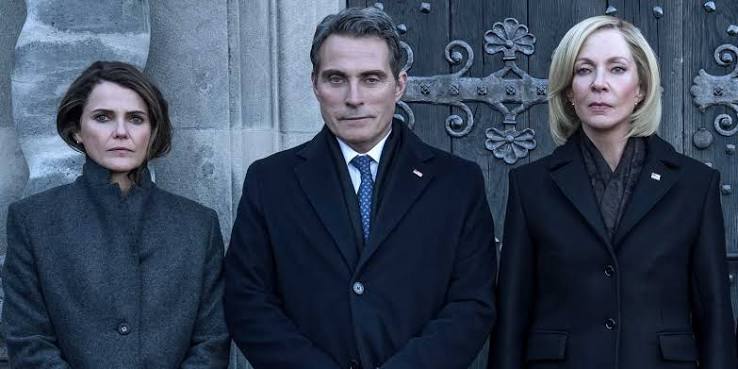
If there is one thing The Diplomat has made abundantly clear over four seasons, it is that negotiating international relations might actually be easier than navigating a marriage. After all, diplomats have protocols, talking points and carefully constructed strategies. Love? Not so much.
“It’s a disaster,” creator, writer and showrunner Debora Cahn said with a laugh during a recent press conference when asked whether love is a diplomatic asset or the ultimate conflict of interest. “Haven’t we made that clear? We’ve been trying to make that clear for four years.”
The Netflix political drama returns Oct. 15 for its fourth season, and the stakes are more personal than ever. With shifting allegiances, complicated marriages and a dangerous conspiracy threatening to upend the balance of power at home and abroad, the series once again finds its sweet spot at the intersection of international intrigue and messy human relationships.
At the center of it all is Keri Russell’s Kate Wyler, the American diplomat whose professional ambitions have become increasingly intertwined with her complicated marriage to Hal Wyler, played by Rufus Sewell. Season four brings a significant shift in their dynamic as Hal’s political influence grows, forcing both to confront what happens when the partnership they have built around ambition and mutual support becomes something altogether more complicated.
Russell, who also serves as an executive producer, says one of the pleasures of playing Kate is that she rarely gets to enjoy a victory for very long.
“You never want to be winning too long in a character because that’s not the fun stuff,” she explained. “So you start with one goal, and then you get thrown three other things to juggle. And that’s the fun of good drama.”
For Russell, the experience of returning to the series has been particularly rewarding. The actor, who turned 50 this year, said she is having more fun working than ever before.
“It’s the best,” she said.
The chemistry between Russell and Sewell remains one of the show’s essential ingredients, but their characters’ shifting positions make the marriage a moving target. As Hal gains the access to power that he and Kate have long discussed, he must consider whether the ambitions that once united them will continue to serve them both.
Sewell describes the season as an education for Hal, who discovers that occupying a position of authority does not necessarily mean behaving as others might expect.
“One of the surprises is that he finds he is kind of hugely impressed by her and finds that he actually wants to be in a position of help to support her,” Sewell said.
That realization creates an intriguing new tension. Hal’s political instincts and his instincts as Kate’s husband have often been difficult to distinguish, but season four begins to explore where those impulses might diverge.
As Sewell put it, the question becomes what happens when someone finally gets into the room they have fought so hard to enter. “Once you’re in the room, what happens to the things that you thought you brought with you?”
It is a question that applies to both the personal and political sides of The Diplomat. Power can be intoxicating, but it can also expose fault lines that were easier to overlook when everyone was working toward the same goal.
Russell sees the shifting balance between Kate and Hal as a natural part of a long-term relationship. “Hopefully, you know, if it’s a healthy long-term relationship, the power’s gonna change many times,” she said. “One person has the power for a couple years, and then someone else gets the power.”
That sounds reasonable in theory. In practice, as Cahn’s series repeatedly demonstrates, knowing that change is coming does not necessarily make it easier to handle.
“The awareness of it helps zero,” Cahn said of the characters’ attempts to prepare for their evolving relationships. “And then navigating it, no matter how ready you are, and you think you’re prepared, you don’t, until you experience it, have any idea what you’re gonna do.”
If the Wylers are learning to navigate their changing status, President Grace Penn and her husband, Todd, face an even more pronounced imbalance. Played by Allison Janney and Bradley Whitford, respectively, the couple must figure out how to maintain their marriage when Grace’s responsibilities as president increasingly compete with her role as a wife.
Grace’s ascent to the presidency has placed her in a position of enormous authority, but it has also left her increasingly isolated. Asked whom Grace can trust in her inner circle this season, Janney offered a succinct answer.
“No one.”
The actor explained that Grace must increasingly rely on her own judgment and instincts as the political situation deteriorates. Even people who once appeared to be allies may no longer be able to offer the kind of support she needs.
“I think she has to double down on trusting herself and her instincts,” Janney said.
That determination has consequences at home. Grace’s relationship with Todd becomes strained as she moves into unfamiliar territory, including a degree of vulnerability she would rather not acknowledge. While Todd wants to protect his wife, his presence can also make her question herself at precisely the moment she is trying to establish authority.
“Grace the president is needing less and less the Grace the wife,” Janney explained. “She needs to separate herself from that a bit.”
And when Todd becomes an uncomfortable reminder of the personal side of her life, Grace has a presidential solution: send him away.
“She doesn’t need him right now,” Janney said. “He’s making her question herself. So she sends him away. Because she can. She’s the president.”
Grace appoints Todd a special envoy, giving him an impressive title and a new assignment that conveniently puts some distance between them. Janney stressed that Grace still loves her husband, but her need to maintain control has taken precedence.
“I don’t think she has any intention leaving him,” she said. “I just think she doesn’t need him right now.”
Whitford, meanwhile, approaches Todd’s predicament with a mixture of concern and deliciously awkward humor. He worries that Grace’s sudden elevation to the presidency, coupled with the pressure to appear strong, could distort her judgment.
The situation also raises questions about how people respond when they find themselves in positions they never expected to occupy. Whitford pointed to the complicated emotional response that can follow a traumatic event, particularly when a leader feels compelled to project strength rather than acknowledge vulnerability.
“Is she really being able to be herself in these circumstances?” he asked. “Or is she trapped in response and needing to seem strong? And putting herself and the world in jeopardy.”
For Whitford, the interplay between public responsibility and private intimacy is central to the show’s appeal. The characters are trying to do the right thing while managing their own insecurities, ambitions and conflicting loyalties — not always with much success.
His own scenes with Russell provide another source of comic tension. Todd and Kate are hardly natural companions, and their interactions introduce an entirely different rhythm into the series.
Russell recalled laughing so hard during some scenes with Whitford that she would be left in tears, forcing the hair and makeup team to make repairs before filming could continue.
“The fun of being at this point in it is, someone else is like dropped into the equation and it just changes the whole dynamic,” she said.
Whitford relishes the discomfort. “There’s just this like delicious cringe because either I don’t want to be in the scene or the people in the scene don’t want me to be in the scene,” he said. “It’s really excruciating. And really a lot of fun.”
That mixture of tension and comedy has become a signature of The Diplomat. Even as the series tackles high-stakes geopolitical maneuvering, its characters remain gloriously human, prone to awkward encounters, bruised egos and emotional miscalculations.
Cahn’s writing also allows the performers to shape their characters in unexpected ways. The showrunner said she begins adapting to the actors’ rhythms as early as possible in the writing process, using their performances to discover which character traits are most compelling.
“I’m kind of like putting out a little buffet and seeing what they pick up,” she said. “And then they gravitate towards some characteristics and not to the others, and then we write toward that.”
The results can be especially revealing in the editing room, where small performance choices become clearer when scenes are viewed together. Cahn praised Whitford’s work on Todd, noting that she recognized the full impact of his choices only after watching the footage assembled.
It is a testament to the ensemble that the show’s political and personal storylines can operate on such different registers without losing their connection. A tense exchange about national security can give way to a painfully funny marital standoff, often with both scenes revealing something about the same character.
Yet the series is not simply a satire of Washington or a cynical portrait of power. Whitford believes one of its distinguishing qualities is its faith in the possibility of meaningful relationships, even when they are difficult.
“There’s something, as difficult as these challenges are that these relationships face, Debora, despite herself, I think is very optimistic about complicated long-term relationships,” he said. “And that’s an almost radical idea, and is a little bit of the kinda magic sauce in here, I think.”
He added that Cahn’s underlying message is that the struggle is worth it — a perspective that extends beyond marriage to the difficult work of public service.
That commitment to public service is something Russell says the cast has come to appreciate through its research and encounters with members of the Foreign Service.
“One of the things we always say about the show is that it’s absolutely supposed to be a love letter to the Foreign Service,” she said. “They’re so bright, they are so curious, they’re so effective, and they could be doing anything, and they’ve given their life to service.”
For Russell, learning more about the people who work in diplomacy has offered a deeper understanding of the demands of their profession and the dedication required to do it well.
Whitford shares that appreciation, particularly at a time when cynicism about government and public institutions can be tempting.
“It’s so easy to be cynical about public service,” he said. “And that has led us to a very difficult place on the planet.”
Instead, Whitford believes the show takes “an unironically heroic and I think realistic look at the difficult necessary work that these people do.”
That perspective informs Cahn’s approach to the political storylines. Rather than trying to reproduce every headline, she looks for the larger geopolitical forces shaping the world and the questions diplomats are likely to confront as a result.
“We can’t keep up with the front page,” Cahn said. “The front page is a Marvel comic right now, and we’re just being whipsawed through a complete overturning of the world order as we know it.”
Rather than chase individual news events, Cahn is interested in the broader transition from a unipolar world toward a multipolar distribution of power, and in how American diplomats navigate that uncertainty.
For those diplomats, she suggested, a recurring concern has been when someone with the necessary expertise will finally be allowed to enter the room and do the job.
It is a question that gives the series a sense of urgency without sacrificing its character-driven storytelling. The geopolitical stakes may be enormous, but the people making decisions remain vulnerable to pride, fear, ambition and love.
Season four also delivers some striking visual set pieces. Cahn described the production’s recreation of Windsor Castle as an elaborate puzzle, filmed across two continents and approximately 11 locations. Director Alex Graves worked out how to assemble the different locations into a convincing whole, while the production enlisted a former commander of the Queen’s Guard to help ensure authenticity.
Every soldier portrayed in the scenes involving the Guard was genuine, Cahn noted, adding that the production had learned from earlier attempts to fake the effect.
The attention to detail reflects the care that has helped sustain the series across four seasons. But for Russell, the real draw remains the writing and the opportunity to explore characters who never stop surprising her.
She credits Cahn with balancing intelligence, humor and a willingness to believe in both relationships and the country, even while acknowledging their many flaws.
“She’s not jaded about relationships or marriages, ultimately. Or the country, ultimately,” Russell said. “And that is what is unique about her voice.”
Ultimately, The Diplomat continues to thrive because it understands that power rarely stays in one person’s hands — and that relationships are constantly being renegotiated, whether the people involved are ready for it or not.
As season four puts Kate, Hal, Grace and Todd through new professional and personal upheavals, the question is not simply who will emerge with the most power. It is whether any of them can hold on to the relationships and principles that made that power worth pursuing in the first place.
For a show that has spent four seasons proving that love and diplomacy are equally treacherous enterprises, the answer is unlikely to be straightforward. And that is precisely the fun of it.