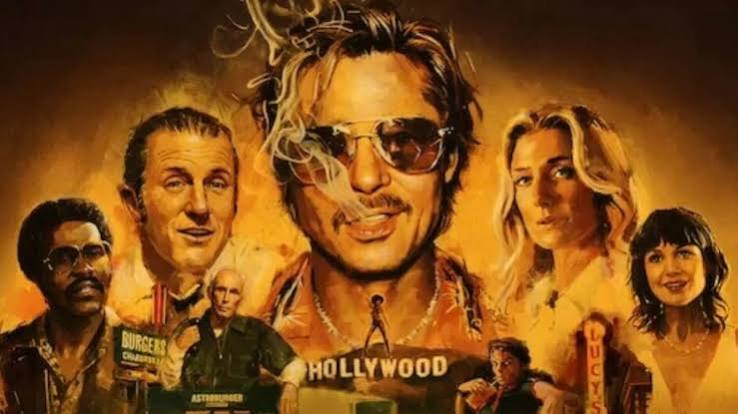
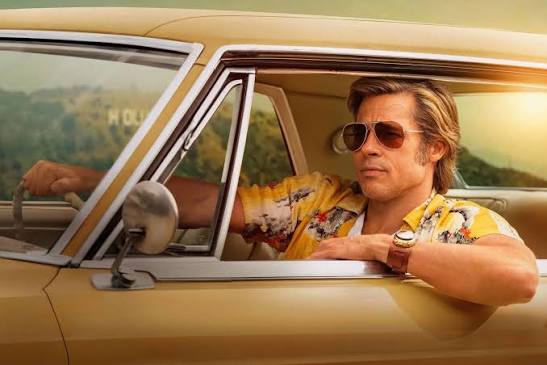
Do you want to see Brad Pitt dialing a rotary phone? How about sniffing some of his shirts to see which one works for a meeting, or watching the actor expertly whip up a series of fresh fruit margaritas at a happening bar in LA?
Those are just a few of the memorable scenes in the highly anticipated new film, The Further Mis-Adventures of Cliff Booth. David Fincher directed it from a script by Quentin Tarantino.
It’s a stand-alone follow-up to Tarantino’s 2019 blockbuster Once Upon a Time… in Hollywood, which won Pitt the Oscar for best supporting actor as stuntman Cliff Booth. This time Cliff is the lead, and the film has 143 minutes to show why that’s a good idea. It really is.
The story is set in 1977, eight years after the first film. Rick Dalton, formerly portrayed by Leo DiCaprio, has moved to Australia for a TV series, so Cliff no longer has a regular stunt job. He keeps busy anyway. He runs the projector at the New Beverly (inside joke: Tarantino now owns that cinema), tends bar at several spots around town, and competes in a demolition derby in Carson. He also works as a fixer for powerful Hollywood friends, quietly making their problems go away, albeit with a bit of force and sometimes a dead body in a trunk.
The trouble, of course, is that Cliff’s new career puts him in the middle of some very interesting company. And that’s where the film really takes off.
His latest assignment comes through Karen Crosby (Elizabeth Debicki), a sharp, well-connected talent agent who needs help with a client, television megastar Charlie Peters (Scott Caan). Charlie is the sort of actor who likes to do his own stunts, which makes him something of a kindred spirit for Cliff. But being a big television star in 1977 comes with its own collection of headaches, and Charlie’s problems are about to become Cliff’s headaches.
Debicki is terrific as Karen, bringing intelligence, sophistication and a healthy dose of Hollywood savvy to the proceedings. She is no wide-eyed newcomer who needs Cliff to explain how the business works. As a former film critic who switched careers and has been an agent for nearly a decade, Karen knows the industry, knows its players and knows how to get things done. Her relationship with Cliff adds another intriguing–and sexy– dimension to the story.
Then there’s Charlie’s wife, Toni Peters (Carla Gugino), who knows considerably more about the Hollywood game than she might initially let on. Gugino gives the character a knowing, slightly mysterious quality that makes you wonder what she’s thinking even when she’s smiling. Perhaps she’s remembering a role she once had in a “POS” movie, during which she met both Cliff and Charlie.
Caan, meanwhile, makes a lively impression as a television star whose appetite for action and celebrity has landed him in a complicated situation. He’s a nice addition to the film’s collection of characters who are convinced they’re in control of their lives. They aren’t always right.
And just when Cliff thinks he’s got a handle on things, along comes Roderick “Hot Rod” Harrison (Yahya Abdul-Mateen II), a former professional football champion who has reinvented himself as a movie star. He’s another colorful member of Charlie’s crew, and Abdul-Mateen brings plenty of presence to the role. The character is an interesting reflection of Hollywood’s ability to turn almost anybody with the right look, connections and ambition into a screen star. Shades of OJ Simpson.
The biggest complications come courtesy of the Verdusco brothers, Eddie and Fernando (Matt Groove and JB Tadena), a pair of mysterious gangsters from Manila who arrive in LA on a mission of revenge.
They bring a distinctly dangerous energy to the picture. Cliff may be comfortable dealing with Hollywood egos, drunken stars and people who need a little discreet persuasion, but these guys are operating on a different level. Their presence turns what might have been a relatively straightforward fixer assignment into a much larger and more violent escapade.
The film’s supporting cast is packed with familiar faces, including Peter Weller as Cliff’s father Gus Booth (spoiler alert: they live together), Corey Fogelmanis and Karren Karagulian. Timothy Olyphant also appears as actor James Stacy, adding another connection to the Hollywood world of the period.
And for fans of the original film, there’s plenty of pleasure in hearing what happened to Rick Dalton, mainly in conversations between Cliff and his father.. Although DiCaprio doesn’t reprise his role, Rick’s absence cannot be ignored.
Tarantino’s screenplay supplies the colorful characters, sharp dialogue, unexpected detours and deliciously unpredictable violence. Fincher, meanwhile, brings a different sensibility. He’s a director who knows how to build suspense, create atmosphere and make even an ordinary conversation feel as though something potentially disastrous is about to happen.
Fincher has described the film as an LA story rather than simply a Hollywood or stuntman story. He has also cited the 1975 comedy-drama Shampoo (starring Warren Beatty as a hairdresser to the stars) as an influence, with its portrait of the strange characters and shifting social landscape of Los Angeles.
The movie takes us into a 1977 Los Angeles of vintage cars, busy bars, movie-industry power brokers, fading television stars and ambitious newcomers. It’s a world where everybody seems to know somebody who can make a problem disappear — and where the person making that problem disappear might be Cliff Booth.
Ultimately, this is Pitt’s show, and he seems to be having an enormous amount of fun.
What’s so appealing about Cliff is that he’s simultaneously a tough guy, a charmer, a bit of a loner and someone who seems perfectly happy to spend an evening mixing drinks or watching a movie. He doesn’t need to be the center of attention. In fact, his greatest talent may be his ability to walk into a room, figure out what’s going wrong and quietly take care of it.
Pitt has always been particularly good at playing characters who don’t appear to be trying very hard. Cliff’s casual confidence, dry humor and occasional flashes of menace make him a terrific leading man.
The movie also asks an interesting question: What happens when a man whose professional identity was built around somebody else’s movie-star career has to create a new one of his own?
The answer, apparently, involves a lot of bartending, a little movie projection, some questionable company and a whole lot of trouble.
At 143 minutes, The Further Mis-Adventures of Cliff Booth is hardly a quick visit to the movies. But with Pitt at the center, Tarantino supplying the words and Fincher orchestrating the mayhem, there’s plenty to keep audiences entertained.
And if you happen to leave the theater wondering whether you should take up bartending, buy a rotary phone or learn how to drive in a demolition derby, well, that’s just part of the Cliff Booth experience.
(The film opened in IMAX theaters on November 25, with its Netflix streaming debut scheduled for December 23, 2026.)