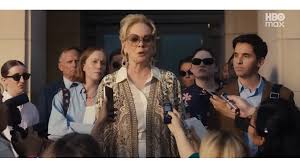
When we last saw Jean Smart’s Deborah Vance on Hacks, she was going through an existential crisis. The Emmy-winning comedy about the legendary stand-up and late night host and a prickly young writer who upended her life has spent five seasons threading the line between brutal honesty and big, cathartic laughs.
Season 5 picks up in the aftermath of one of the show’s boldest swings yet: Vance confronting the premature reporting of her own death. For co-creator Lucia Aniello, that narrative twist becomes the engine for the show’s final act. Deborah, she explained, is suddenly forced to reckon with how she’s perceived versus how she wants to be remembered. “If this is what they’re saying about me,” Aniello said, “what do I want this to say about me?” The season becomes a meditation on legacy—not just in the abstract, but in the granular details of relationships, work, and the city that made her, Las Vegas.
That question of legacy extends behind the scenes as well. Co-creators Paul W. Downs and Jen Statsky admitted that the final season became a kind of creative wish list: a last chance to execute long-discussed ideas that had been percolating since the beginning. That includes an absurdist flourish Downs has been pitching for years—a camera shot that literally travels into a character’s mouth. “Everyone said no,” he joked. “But in a nightmare scenario? Finally.”
That sense of creative freedom translates onscreen into a season that is, by design, both expansive and deeply personal. Statsky described it as a “Wizard of Oz” journey, with Deborah at the center and the full ensemble—Jimmy, Kayla, Marcus, and more—coming together in a way the show has never fully attempted before. It’s a structural shift that mirrors the emotional one: this time, everyone is part of the goodbye.
For Smart, who has defined Vance as one of television’s most indelible characters, the final season offers a tonal reset after the darker turns of Season 4. “We get to get back to being profoundly silly,” she said, clearly relishing the return to the show’s comedic roots. But the lightness comes with weight. Deborah’s struggle against forces trying to control her narrative—corporate pressures, shifting industry dynamics—feels especially timely. Smart pointed to the unsettling reality of an entertainment landscape increasingly shaped by powerful gatekeepers, noting that Deborah reaches a breaking point where she feels “absolutely defeated”… before, inevitably, fighting her way back.
That push and pull—between defeat and defiance, cynicism and connection—has always been the show’s lifeblood, and nowhere is it more potent than in the evolving relationship between Deborah and Ava. Hannah Einbinder described the final season as a rare opportunity to see the two characters “on the same team,” even as their signature sparring remains intact. It’s a dynamic that has matured alongside Ava herself. “The difference between a 24-year-old and a 30-year-old is huge,” Einbinder said, reflecting on the character’s growth. “She’s been changed for the better by Deborah.”
That growth is mirrored across the ensemble, including Megan Stalter’s Kayla, who has transformed from chaotic liability to surprisingly competent—and deeply devoted—partner. Stalter, in typically unfiltered fashion, described the character’s journey as both professional and emotional: Kayla didn’t just learn how to do her job; she learned how to love, specifically Jimmy. “She became someone who actually was good,” Stalter said, before half-jokingly asking the room if anyone else was getting emotional. Yes, they were.
If the show itself balances comedy and heartbreak, a recent panel of the creators and actors mirrored that tone almost uncannily. Conversations about the industry’s future—particularly the encroachment of AI—took on a sharper edge. Statsky didn’t mince words, calling out the tech industry’s obsession with “optimizing” creativity at the expense of humanity. “The grit and the struggle is part of it,” she said. “That’s what makes things good.” Downs echoed the concern, pointing to the lack of regulation and the broader implications for truth and free speech. Smart also weighed in, noting the potential erosion of imagination in a screen-saturated world.
And yet, for all its big ideas, Hacks remains rooted in something more intimate: the bond between its characters, and the people who bring them to life. Nowhere was that clearer than in the cast’s recollections of their final days on set.
Stalter’s goodbye was, by all accounts, operatic. She described “screaming and crying” through her last scene, comparing the end of the show to having “a golden fork ripped from my hands” and being left with “a stupid plastic fork.” It was funny, alarming, and deeply sincere—much like Kayla herself. “I didn’t handle it very well,” she admitted. No one disagreed.
Smart’s experience was quieter but no less poignant. As the show’s sets were dismantled one by one, the reality of the ending began to sink in. “That’s a series wrap on Deborah’s bedroom,” she recalled hearing, a moment that hit with unexpected force. “We’re never going to sleep in this bedroom again?” she said, describing the surreal feeling of saying goodbye not just to a role, but to a physical world she’d inhabited for years.
Einbinder, for her part, spoke about the strange, lingering connection to Ava—keeping pieces of her wardrobe, feeling as though she was holding onto a friend. “They’re real to us,” she said simply.
Even the creators, still in the thick of editing the finale, struggled to articulate what the ending will mean. Downs offered only that it encapsulates everything the show set out to do from the very beginning: a story about legacy, about what we leave behind. Smart, who deliberately avoided learning the ending in advance, admitted she was initially unsure—but ultimately came around. “Now I think it’s kind of perfect,” she said.
If *Hacks* has always been about reinvention—about refusing to be defined by the past—its final season seems poised to honor that ethos while also embracing something more rare: closure. Not neat or easy, but earned.