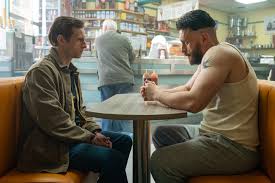
When you start watching Half Man, it grabs you by the collar and refuses to let go. Created by and starring Richard Gadd, the new HBO drama is an often brutal exploration of masculinity, trauma, and the long shadows cast by youth.
Spanning decades and emotional extremes, the series tracks the volatile bond between two men, Ruben –vividly portrayed by Gadd– and Niall, played by Jamie Bell, tracing how childhood wounds calcify into adult damage. As executive producer Sophie Gardiner explains, the scale of the story was essential to unlocking its emotional truth: “In order for that to be complex and subtle and nuanced, we needed that level of scale… it’s about how what happens in the past impacts upon the present.”
From the outset, Gadd resisted the urge to build the show around a thesis or tidy takeaway. “I’m never too motivated by sort of themes or like world events,” he says. “I usually just sort of need a creative idea to take me in a way.” That idea—two damaged men viewed through the prism of their younger selves—quickly became a creative engine. “That was all I needed really to spark something for me to run with it,” he adds. “And then it just becomes a kind of creative endeavor from that point forward.” Even as the show grapples with big ideas—male rage, repression, identity—it never feels didactic. Instead, it unfolds as something messier and more intuitive, driven by character rather than commentary.
Gardiner emphasizes that this refusal to simplify is what gives Half Man its edge. “The thing that really interested me most… is the ‘why’ people behave the way they do,” she says, pointing to the “complicated interaction” between family, environment and personal history. That complexity extends to the show’s tone, which can pivot from biting humor to devastating trauma in an instant. “It really is everything,” she says of Gadd’s writing. “It’s huge, it’s epic, it’s small, imperfect… and that makes it utterly distinctive, but it’s also true to lives lived.”
At the heart of the series is a deliberately uncomfortable portrayal of violence—not as spectacle, but as consequence. Gadd is clear-eyed about why he refuses to soften those edges. “In a show where you explore the extremities of male violence, you have to show how extreme that can go,” he says. “Otherwise, you’re robbing the audience of the truth.” For him, every brutal moment is rooted in character: “I think where sex and violence fall down on television is where it’s gratuitous… Every time you see something challenging within the show, it leads to plot development, leads to character psychology going deeper.” The goal isn’t to shock, but to contextualize—to trace how trauma mutates into action. “A lot of violence comes from deep psychological trauma,” he adds. “And I wanted to get that through the characters.”
That same philosophy shapes how Gadd approaches morality within the story. “I don’t see them as heroes or villains,” he says of Ruben and Niall. “I think everyone’s a mixture of good and bad… people are full of contradictions.” Gardiner echoes that sentiment, noting a recurring thread in how the characters perceive themselves: “There’s a theme… about victimhood and moments when they feel like they’re victims and decisions that they make on the back of that.” It’s not about labeling anyone as good or evil, but about examining the choices people make when they feel wronged—and how those choices ripple outward.
Even the show’s structure—moving back and forth across time—serves that larger inquiry. By withholding later episodes from the younger actors, Gadd ensured their performances remained rooted in instinct rather than inevitability. “There was always a worry that if we had too much knowledge of where the characters are going, that that would influence things in the wrong way,” he explains. What he wanted to preserve was “the hope of life that you have when you’re a teenager… that anything is possible,” even as the audience knows that hope will erode.
If Half Man feels relentless, it’s because Gadd refuses to dilute its emotional intensity—not for the sake of audience comfort, nor for easy answers. “If I spent my life worried about reactions… then I think you’re not going to ever write good art,” he says. “All I really sit down every day to do is write the best possible story.” That philosophy extends to how he views the audience itself. “I never want to patronize my audience,” he adds. “I think people are a lot more clever than sometimes we give them credit for… we like to be challenged.”
And yet, for all its ambition and brutality, Gadd insists his goal is surprisingly simple. He isn’t trying to define masculinity or solve its contradictions—if anything, the process only deepened the mystery. “No, I’m almost further away,” he admits when asked if he understands the bond between men any better. “I never set out to find answers.” What remains instead is something more elusive: a portrait of two lives bound together by love, damage and need, leaving viewers to wrestle with their own interpretations long after the final frame. “At the end of the day,” Gadd says, “I’m just somebody who wants people to like it… I just hope people enjoy it.”