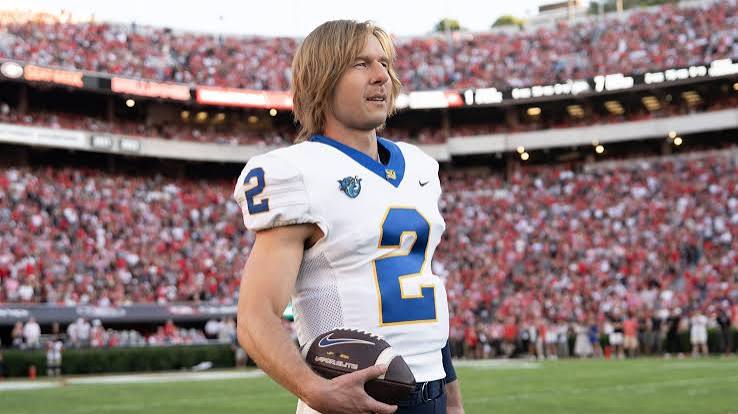
Who isn’t a bit enchanted by actor Glen Powell’s comedic charade as disguised quarterback Chad Powers?
That may be the secret weapon behind Season 2 of Hulu’s Chad Powers, the irreverent sports comedy that turns one of Hollywood’s most charismatic leading men into one of its most ridiculous creations. Powell returns as the titular former college football phenom Russ Holliday, still hiding behind the prosthetics, swagger and spectacularly questionable personality of Chad Powers as he attempts to resurrect a football career that he nearly destroyed the first time around.
The disguise is ridiculous. The Southern-inflected bravado is even more laughable. And Powell’s willingness to completely surrender his movie-star image to the joke is what makes the whole thing work.
Season 1 established the premise: Holliday, a gifted quarterback whose arrogance and bad judgment torpedoed his career, adopts the identity of Chad Powers and walks onto a struggling college football team in hopes of getting another shot at the game. What begins as an elaborate deception becomes something considerably more complicated as Russ finds himself forming genuine relationships with teammates and coaches while constantly risking exposure.
Season 2 picks up that increasingly precarious balancing act and expands the world around him. Chad is no longer simply trying to prove that he belongs on the field. He has to figure out whether the person underneath the disguise can actually become the player — and, more importantly, the man — he was never capable of being as Russ Holliday.
Powell remains the show’s irresistible center. There is something inherently funny about watching an actor who has become one of Hollywood’s most recognizable leading men deliberately make himself look absurd. Chad Powers is not a slick disguise. He is conspicuous, overconfident and just a little bit unsettling. Powell plays him with the kind of commitment that prevents the character from becoming merely a one-note sketch.
That commitment is particularly important because Chad Powers has always been more than a collection of football jokes. Beneath the broad comedy is a familiar redemption story: a talented athlete who blew his opportunity gets another chance, only this time he has to earn it. The irony is that Russ may have to spend his second chance pretending to be somebody else before he can finally become the person he should have been all along.
The series also understands that college football is an almost endlessly fertile setting for comedy. The egos are enormous, the stakes are often outsized, and every locker room has its own hierarchy, insecurities and rivalries. Chad’s presence disrupts all of them. His teammates don’t simply have to deal with an unconventional quarterback; they have to deal with a quarterback whose entire existence is essentially a performance.
And the better Chad becomes at football, the more dangerous the deception becomes.
That gives Season 2 a particularly useful comic engine. Every success creates another problem. The more people believe in Chad Powers, the harder it becomes for Russ Holliday to tell the truth. Every new relationship raises the emotional cost of being exposed. What was initially a stunt gradually becomes a prison of his own making.
Powell, who has demonstrated his dramatic range in films ranging from Top Gun: Maverick to Anyone But You and Twisters, clearly relishes the opportunity to go broad. His Chad is a walking collision between confidence and incompetence — the kind of guy who can enter a room convinced he is the smartest person there and leave having accidentally destroyed the furniture.
That contrast is the show’s comic sweet spot.
Season 2 also benefits from the fact that viewers already know the secret. The suspense is no longer simply whether Chad will be exposed. It’s what will happen when the increasingly elaborate life he has constructed collides with the truth about Russ. The audience gets to enjoy the joke while watching the character struggle to keep it alive.
There is also an appealing absurdity to the show’s central conceit. In an era when sports documentaries routinely turn athletes into carefully managed brands, Chad Powers is practically the anti-brand: a manufactured personality whose greatest asset may be his complete lack of self-awareness. He is simultaneously an athlete, an alter ego and an elaborate excuse.
That makes Powell’s performance even more entertaining. The actor isn’t afraid to look foolish, and Chad Powers is at its best when it lets him. Whether Chad is attempting to establish himself in the locker room, navigate the increasingly complicated relationships around him or simply convince everyone that his bizarre persona is perfectly normal, Powell plays every moment as though Chad has absolutely no idea how ridiculous he looks.
The show’s appeal ultimately rests on the combination of sports comedy, character comedy and the very old-fashioned pleasure of watching a spectacularly flawed person get another shot. Chad may be a fraud, but his desire to succeed is genuine. Russ may have created Chad to save his career, but the disguise may force him to confront why he lost it in the first place.
Season 2 therefore has a larger question hanging over all the jokes: Can Russ Holliday change without Chad Powers?
For a series built around a man pretending to be someone he’s not, that’s surprisingly sincere territory.
Fortunately, Chad Powers never forgets that it is a comedy. The football remains chaotic, the personalities remain oversized and Powell remains completely committed to the ridiculousness of the character. The result is a second season that understands its greatest asset isn’t simply the disguise. It’s the actor underneath it, gleefully tearing apart his own movie-star persona one bad decision, ridiculous haircut and questionable quarterback move at a time.