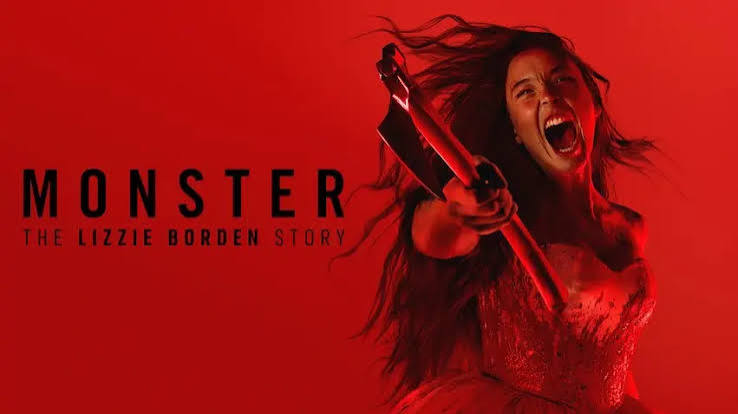
Lizzie Borden has been part of the American cultural imagination for more than a century, immortalized in a nursery rhyme, countless books, movies and television shows—and, of course, the enduring question of whether she really did it.
Now she gets the Monster treatment.
Monster: The Lizzie Borden Story is the fourth installment of Netflix’s hit anthology series from Ryan Murphy and Ian Brennan, following Monster: The Jeffrey Dahmer Story, Monsters: The Erik and Lyle Menendez Story and Monster: The Ed Gein Story. But this time, the “monster” at the center of the story is a woman—the first female subject of the series. Brennan, who serves as creator, writer and showrunner, once again uses a notorious real-life crime as a jumping-off point for a much larger examination of the psychology and circumstances surrounding the person at its center.
The eight-episode season stars Ella Beatty as Lizzie, with Vicky Krieps as the Borden family’s rebellious live-in maid Bridget “Maggie” Sullivan, Rebecca Hall as Lizzie’s stepmother Abby, Charlie Hunnam as her father Andrew, Billie Lourd as her sister Emma and Jessica Barden as actress Nance O’Neil. Sarah Paulson also joins the story as another infamous woman whose name has become synonymous with female violence: Aileen Wuornos.
That connection is one of the season’s more intriguing twists. Wuornos, whose life and crimes were dramatized in Patty Jenkins’ 2003 film Monster, earned Charlize Theron an Academy Award for her portrayal. Here, Paulson takes on the role, with the story jumping forward nearly a century to show how Lizzie’s legend reaches another woman accused of horrific crimes. Netflix describes Wuornos as an inheritor of Lizzie’s bloody legacy, while Brennan has said the character could easily have been the subject of an entire season herself.
It’s a fitting addition to a season increasingly interested in a question that the earlier installments approached primarily through male perpetrators: What happens when a woman reaches the point of violence?
“When you look at these stories, there’s always some sort of repression,” Brennan said during a press conference. “All of us can murder. We can all kill. Every human being can kill, and just some of us don’t.”
The Lizzie Borden case is particularly fertile territory because the central mystery has never been completely resolved. Lizzie was acquitted of the 1892 murders of her father and stepmother, but the question of what actually happened inside the Borden home in Fall River, Mass. has never gone away. Brennan is willing to take a position in the fictionalized version.
“I think she did do it,” he said, while acknowledging that he could be wrong.
That uncertainty gives the series room to do what Monster has done from the beginning: take a notorious case with a known outcome and fill in the psychological blanks. Rather than simply recreating the trial or ticking off the familiar facts, the series imagines the emotional world that might have existed behind the headlines.
For Beatty, that meant approaching Lizzie as a human being rather than simply a historical murder suspect.
“I felt incredibly lucky to be the first woman monster,” Beatty said. She also understood from the beginning that Murphy and Brennan were interested in exploring why women kill and asking the larger question of whether someone is “born or made.”
Beatty researched Lizzie extensively, reading The Trial of Lizzie Borden and digging into the conflicting accounts surrounding the case. But she ultimately had to decide where historical fact ended and the series’ fictional interpretation began.
“Mainly I felt my job was to explore the character that Ian and Ryan had created,” she said. “I could take all the source material about the real person’s life and translate that into the very fictionalized version of the woman that we created for the show.”
That distinction is important because there is surprisingly little reliable information about the private life of the real Lizzie. The series therefore takes liberties, imagining what might have been happening behind the closed doors of the Borden household—and particularly what Lizzie’s relationship with Maggie might have meant.
The result is a Lizzie who is suffocating under the rules of Victorian society, with her frustration increasingly turning into something darker.
Max Winkler, who directs and executive produces the season, sees the story as extending well beyond one infamous Massachusetts murder case.
“It’s about female rage,” Winkler said, pointing out that American women could not vote until 1920. The series, he explained, connects Lizzie to generations of women who were “put in cages” by the circumstances of their lives and eventually fought back.
Hall, meanwhile, approaches Abby Borden as more than a conventional wicked stepmother. Her character is oppressive, cruel and often disturbing—but Hall sees that cruelty as part of the same cycle of oppression that has trapped Lizzie.
“I think it’s causal,” Hall said. “I think Abby is also a product of oppression.”
Her solution, however, is considerably less sympathetic: Abby “deals with it by turning into sort of a raging sadist.”
Hunnam found a different kind of emotional cage in Andrew Borden. He doesn’t consider Andrew particularly innocent, but he also found himself feeling unexpectedly tender toward the character, a man trapped by grief, dissatisfaction and his own inability to escape the emotional confines of his life.
The actors also had to contend with the very physical restrictions of the period. Hall summed up the biggest challenge in one word: “Corset.”
For Beatty, the corset became more than a costume detail. It helped her understand the physical confinement of a woman living in that era and became part of the character’s psychology.
She approached the performance by asking deceptively simple questions: How does Lizzie walk? How does she listen? How does she breathe? How does she dream?
“I tried to do it scared,” Beatty said.
That physicality extends into the violence. One of the reasons the Lizzie Borden story continues to fascinate is that the image of a young woman wielding an axe clashes so violently with the traditional expectations of femininity. Beatty said that contrast is part of what makes female violence so compelling.
“It’s the psychology,” she said. “Why, how did this person get to this point?”
Winkler similarly sees the shock as rooted in the betrayal of expectations about women as mothers, homemakers and caretakers. When women step outside those prescribed roles—particularly into violence—the reaction can still be unusually intense.
That idea ties Lizzie directly to Wuornos, whose story is introduced later in the season. Paulson’s Aileen is not simply a cameo or a pop-culture Easter egg; her presence expands the show’s exploration of female violence across radically different eras.
In real life, there is no evidence that Wuornos was fixated on the Borden murders, although the series uses Lizzie’s story as an inspiration for its fictionalized account of Wuornos. The real Borden house did eventually become a bed-and-breakfast, which gives the series one intriguing real-world connection between the two women.
Brennan said the parallels between Lizzie and Wuornos became apparent to him only after he had already written and shot much of the story. Both women come from radically different circumstances, but the series uses their stories to examine family dynamics, repression, rage and the ways women respond to the hands they have been dealt.
And, in keeping with Monster tradition, the show isn’t content to wallow in grimness.
Brennan deliberately uses contemporary needle drops and a modern voice to keep the period setting from becoming “stuffy and mildewy.” Winkler described the scripts as surprisingly funny, comparing the tone at one point to a “bizzaro Noises Off.” References to The Heiress, The Age of Innocence, Powell and Pressburger and Kate Bush all helped shape the strange combination of period drama, dark comedy and psychological horror.
That tonal mix also gives the actors room to breathe between the darker scenes. Hunnam, who played Ed Gein in the previous season, said his experience this time was markedly different, and he found plenty of laughter between takes despite the grisly material. Even the production’s authenticity had its hazards: Hunnam smoked pipe tobacco for the role, including off camera, and joked about developing a small addiction before quitting when filming wrapped.
Winkler also joked that Hunnam no longer had to “wear the crown of the monster.”
For Beatty, however, that crown represents something quite different. Lizzie is the first woman to occupy the center of the Monster universe, and the season uses that distinction to broaden the anthology’s ongoing obsession with the question of what turns a person into a monster.
The answer here is deliberately complicated.
Lizzie Borden was acquitted. The historical record is incomplete. The murders remain unsolved in the legal sense. And yet Lizzie became an icon anyway—one whose story has survived for more than 130 years.
Now, through eight episodes, Monster: The Lizzie Borden Story asks viewers to look beyond the axe, the nursery rhyme and the sensational headlines and consider the woman underneath them.
And by bringing Aileen Wuornos into that story, the season suggests that Lizzie’s legacy isn’t simply about one notorious murder case. It is about the enduring fascination with women who refuse to remain inside the cages society has built for them—and what happens when rage finally breaks through.