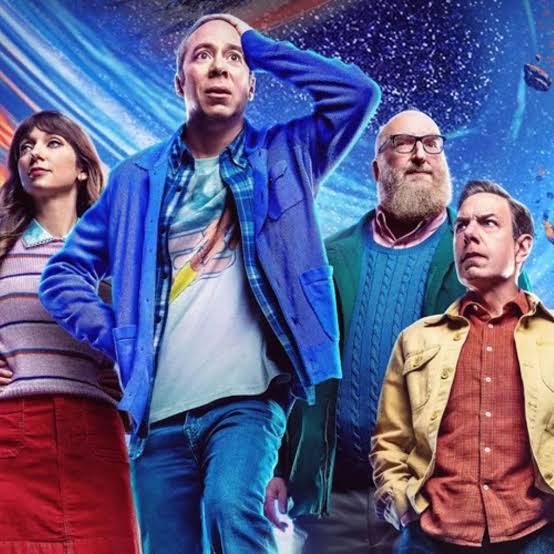
In The Big Bang Theory, Stuart Bloom was the guy standing behind the comic book counter—the socially awkward but lovable store owner whose bad luck often seemed as legendary as his devotion to comics. Now, he’s finally stepping into the spotlight in HBO Max’s Stuart Fails to Save the Universe, an inventive sci-fi comedy that blends alternate realities, visual spectacle and character-driven humor while maintianing its comedic heart.
The series follows Stuart on an impossible mission across a seemingly endless multiverse, where every new reality presents stranger dangers, bigger laughs and increasingly absurd challenges. It’s a bold creative leap from executive producers Chuck Lorre, Bill Prady and Zach Penn, who spent more than a decade nurturing the idea before it finally became reality.
“It began about 10, 12 years ago,” Lorre recalled during a recent press conferencee. “I had this idea that Stuart, in the comic bookstore, there was a portal in the back room to other universes. I’ve always wanted to work in a bigger genre, working with visual effects and computer graphics and all the things that you can do.”
The technology may have expanded the show’s possibilities, but Lorre insists the foundation never changed.
“Something’s funny or it’s not,” he said. “All the special effects and computer graphics cannot make something that’s not funny, funny. We just had to remain honest with ourselves as we wrote these things.”
That philosophy is evident throughout the series, which treats its outrageous science-fiction concepts with surprising emotional sincerity. The multiverse may provide limitless storytelling opportunities, but the comedy always comes from recognizable, wonderfully flawed people trying to survive impossible situations.
“The peril has to be real,” explained Penn. “The characters have to stay who they are, and these characters want to talk about mundane things in the middle of” extraordinary life-and-death crises.
John Ross Bowie summed up that balance perfectly.
“There’s a contrast that runs through a lot of the episodes where crazy things are going on, but we still have our weird little petty grievances,” he said, laughing about one scene where the world’s biggest concern becomes whether someone should “wear layers.”
The cast embraces that wonderfully offbeat tone.
Kevin Sussman, who now carries the series as Stuart, joked that nothing could have prepared him for becoming the unlikely center of a universe-spanning adventure.
“Nothing could help prepare for this role,” Sussman laughed. “That pretty much sums it up.”
The actor says the single-camera format gives audiences an opportunity to discover new layers of Stuart that weren’t always possible before.
“There’s more dimension to their relationship that was really nice to do,” Sussman said of Stuart’s romance with Denise.
Lauren Lapkus agreed, saying the series allows their relationship to develop in meaningful ways despite the increasingly bizarre worlds surrounding them.
“I loved it because I felt like we were able to get to another level,” Lapkus said. “There was some depth to the relationship and they’re going through such extreme situations that their relationship grows through that.”
The show’s ever-changing realities also gave Lapkus the opportunity to play multiple versions of Denise.
“The levels to each character are really fun to explore,” she said.
Every episode introduces audiences to another corner of the multiverse, from post-apocalyptic wastelands and unsettling asylums to seemingly perfect utopias that hide darker secrets.
For Penn, that’s where the writers had the most fun.
“We tried each week… to come up with something that we thought, ‘well they won’t see this coming,’ and we tried to do that pretty much every week.”
Prady especially enjoyed stories that challenged both the audience and the characters.
“What’s being presented is dishonest and you sort of have to figure out what’s going on.”
Despite the massive visual effects and elaborate world-building, the creative team says Stuart Fails to Save the Universe never loses sight of comedy. Lorre even cited one of television’s classic inspirations.
“Mel Brooks had a huge influence on us growing up,” he said. “The lineage from the great Mel Brooks is very much a part of what we did.”
That influence extends beyond jokes to the show’s fearless commitment to treating ridiculous situations with complete sincerity.
As one journalist noted during the press conference, the tone recalls Get Smart, with intelligent humor that trusts its audience.
Prady embraced the comparison.
“Get Smart works because the characters are comedic characters, but the peril is real.”
The ensemble chemistry also proved to be one of the production’s biggest surprises—although perhaps not to the cast themselves.
“We’ve known each other for years,” Lapkus said, noting friendships that predated the series by decades.
Brian Posehn felt the connection immediately.
“From the first day, I felt like, ‘Oh, this is going to work.'”
Prady praised the performers as “four of the most remarkable comedic actors I’ve ever worked with,” adding that each was capable of elevating every scene.
The result is a series that feels simultaneously ambitious and deeply personal. Beneath the portals, alternate realities and spectacular visual effects is the story of an ordinary man trying to do something extraordinary while never quite losing his awkward charm.
Lorre hopes that’s what ultimately resonates with viewers.
“We wanted this show to stand on its own,” he said. “It shouldn’t exclude anyone. Why would you work so hard and then exclude people from participating?”
(Stuart Fails to Save the Universe Premieres on HBO Max July 23 with episodes released weekly.)