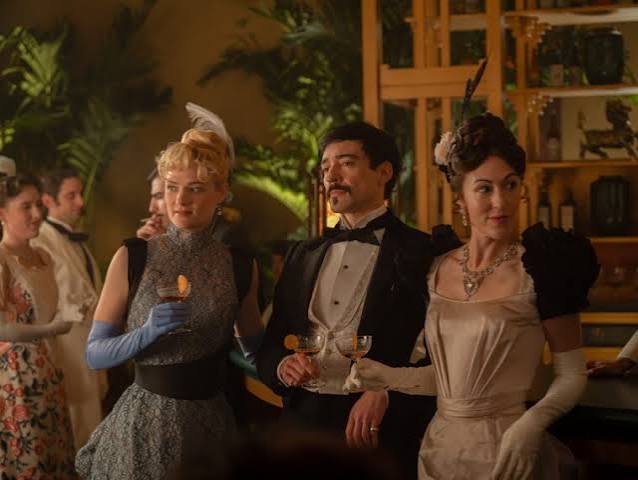
In the world of HBO’s The Gilded Age, money may open doors, a prestigious marriage can secure a family’s future, and the right invitation can determine one’s place in society. But as Season 4 of Julian Fellowes’ lavish period drama makes clear, even the wealthiest and most powerful New Yorkers can find themselves on decidedly shaky ground when the rules begin to change.
For George Russell (Morgan Spector), the season begins with a reckoning. His marriage to Bertha (Carrie Coon) has been shaken, his relationship with daughter Gladys (Taissa Farmiga) has suffered, and the old division between his ruthless business dealings and his devotion to family is no longer holding.
“I think it’s a total life reset for George,” Spector said during an HBO press conference. Having nearly been killed and believing he has “failed his daughter catastrophically,” George must reconsider what it means to be a good husband and father. “His capacity to compartmentalize and be business-ruthless, but kind and loving father at home, that’s all sort of out the window.”
Coon, meanwhile, isn’t ready to let Bertha off the hook—or concede that she was wrong. Asked about the consequences of her character’s determination to secure Gladys’ future, the actress offered a blunt assessment: “Well, I was right. I was right, I’m not ashamed of it. George needs to get his act together.”
But Bertha’s confidence doesn’t necessarily translate into contentment. Coon describes her as a woman who is always looking toward the next achievement, with little room to pause and consider whether she is happy. “Somebody like Bertha is not thinking about that,” she said. “She’s prioritizing, like, maybe there’s contentment, but somebody like Bertha, it’s an unfillable hole. You know, there’s nothing that will ever fill that hole. That engine is always running.”
George’s own sense of purpose has long been intertwined with his marriage. Without Bertha beside him, Spector explained, he is left questioning the point of everything he has built. “I think without Bertha, George is lost, actually,” he said. “All of his business is in service of this family and in service with that relationship.”
Their troubles also affect the next generation. Larry Russell (Harry Richardson) is beginning to understand the complications that come with inheriting his parents’ world. “He’s facing responsibility of the shoulders he stands on this year,” Richardson said, adding that Larry is adopting more of his parents’ qualities while realizing “that comes with a price and complication.”
Gladys, meanwhile, has entered a new chapter as the Duchess of Buckingham. Farmiga sees her character learning to make choices for herself after years of having decisions made on her behalf. “Learning to be respected is going to change her future and the path she walks on,” she said. Even something as seemingly small as choosing the dress she wants to wear becomes a meaningful step toward independence.
The shift has also changed Gladys’ understanding of her mother. As Farmiga put it, “Bertha was right”—a concession that comes with complicated feelings, particularly as Gladys begins defining what she wants her own life to look like.
Throughout the series, the characters’ changing circumstances offer a portrait of women negotiating the limits imposed by their era. For Marian Brook (Louisa Jacobson), that means pursuing a life with purpose rather than simply accepting the future society has mapped out for her.
Jacobson sees Marian’s friendship with Peggy Scott (Denée Benton) as central to that evolution. Peggy was one of Marian’s first friends in New York, and her example helped Marian imagine a different kind of life. Watching Gladys’ marriage unfold also made the consequences of allowing others to dictate a woman’s future impossible to ignore.
“I want to have a purpose in my life and I want to be of service,” Jacobson said, describing Marian’s outlook. In the new season, Marian’s interest in social work becomes increasingly important, placing her among those responding to the changing social landscape of the Progressive Era.
Peggy’s challenges, however, have a different urgency. Benton noted that her character’s struggles can feel surprisingly contemporary, even as the story remains firmly rooted in the 1880s. The distinction matters: the consequences of a woman’s choices were often far more severe in a society where economic security and social acceptance were difficult to achieve independently.
“The stakes were so high and so different and destitution was real,” Benton said.
Peggy’s story also continues to explore divisions within the Black community, including the relationship between class, colorism and the desire for social acceptance. Audra McDonald, who plays Peggy’s mother, Dorothy Scott, said Dorothy is concerned about the consequences of pursuing acceptance by distancing oneself from the broader community.
Dorothy sees the danger in seeking greater proximity to whiteness at the expense of collective responsibility. “We’re still seen as a monolith,” McDonald said, explaining her character’s perspective. “We still can only really move on together, so we can’t cut off any one of our bits and pieces as a race.”
Benton added that integration can also expose economic divisions. “One of the downsides of integration is wealth separation,” she said, allowing classism to become more pronounced. McDonald praised the show’s creators for examining those issues within the Black community, both in the period and today.
It is a reminder that social mobility does not necessarily erase inequality—and that individual success can carry obligations beyond the individual.
Elsewhere, Ada Forte (Cynthia Nixon) continues to surprise those who thought they had her figured out. Her marriage and growing independence have taken her far from the more sheltered woman audiences first met. Nixon said she was delighted by the direction the writers took her character, describing the experience as being assigned one instrument in an orchestra and then unexpectedly handed another.
“I think it’s a wonderful thing that, despite her age, she could fall in love for the first time with someone who loved her back and who chose her,” Nixon said.
That willingness to let characters evolve is one of the show’s strengths. Nixon praised the writers for putting familiar personalities into situations they never imagined facing, forcing them to discover new parts of themselves. “Whatever your life is, it’s probably going to be very different very soon, in good ways and bad ways,” she said.
Oscar van Rhijn (Blake Ritson) and Enid Winterton (Kelley Curran) are also navigating a changed social landscape. Ritson described them as “the new apex predators of high society,” a playful characterization of their position as they find their footing in a world where alliances and reputations are constantly shifting.
Their scenes together bring a different energy to the series, including dancing and a more relaxed approach to the conventions that govern their world. Beneath the social maneuvering, Oscar’s story also continues to explore the risks of being gay in a period when exposure could bring serious legal and social consequences.
Ritson said he has been struck by the response to Oscar’s coming-out storyline. Although the character’s circumstances are specific to his time, the underlying struggle remains relevant. The Gilded Age reaches audiences in more than 60 countries, he noted, including places where coming out is still dangerous or illegal.
That connection between historical detail and present-day experience gives the show’s period setting a contemporary resonance without losing sight of the constraints its characters face.
The series’ elaborate costumes, grand interiors and carefully observed etiquette remain part of its appeal, but the cast also sees value in the social structures the show depicts—and in questioning them.
Benton singled out the architecture, lamenting the prevalence of new developments that sacrifice detail and lasting materials for uniformity. Ritson championed the show’s handwriting, noting that a calligrapher created distinctive styles for individual characters.
Ahlers, who plays Jack Trotter, offered a more unexpected observation: the era’s emphasis on community participation. Although its rules could be oppressive, he said, people were more closely tied to the places where they lived. The wealthy could not simply withdraw from society; if they wanted cultural institutions such as the opera to thrive, they had to help support them.
“There was a sort of forced citizenshipness,” Ahlers said. “They had to invest in their community.”
That sense of shared responsibility provides an interesting counterpoint to the characters’ personal struggles. Their world is built on rigid hierarchies, but it also depends on relationships and institutions that no one can sustain entirely alone.
As Season 4 unfolds, the Russells and their circle must confront the consequences of their choices, whether in marriage, family, work or the pursuit of acceptance. Their fortunes may change, but the series’ most compelling question remains what happens when the lives people have carefully constructed no longer fit who they are becoming.
For all its lavish gowns and drawing-room intrigue, The Gilded Age understands that change rarely arrives with perfect timing—and that even those who seem to have everything can find themselves starting over.